Suck.Com Domain Hijacked by Smut Merchant
Over the holidays, Suck.Com stopped being a failed online magazine for a few days and began a new life as a porn portal. This was apparently a domain name hijack, because the portal's gone and the old site's archives are now restored.While Suck was porn, Steve Baldwin wrote a bitter sendoff:
Given that this is certainly the end of suck.com's long journey as a project, one must ask: was suck.com ever really about anything more than the wiles and whims of its owners? Wasn't this the joke all the time -- that a couple of guys at Wired could rise to the top of the Web with nothing but a talent for inserting hyperlinks in biliously written text and the services of a talented cartoonist named Terry Colon, whose droll drawings actually produced most of the laughs?
Many have suspected that Steadman and Anuff did what they did for the money, the publicity, the women, and the influence, which Suck.com brought them. Sure, they wrote as if they were ink-stained outsiders, but they were insiders all along, and they knew it, and if you were half as smart as they were, which you weren't, you knew it too. That was the ultimate joke that lay at the heart of Suck.com; the very core of its mean-hearted humor. And if you didn't find the joke funny, well, this fact proved that you just weren't smart enough all over again.
I'm a fan of Baldwin, who spent the dot-com boom gleefully puncturing the bubbles of overhyped tech companies and their irrationally exuberant executives, reveling in each dot-casualty at Ghost Sites of the Web. His critique omits something he's admitted in the past -- he worked several months as a Plastic.Com contributor for Automatic Media, Suck's parent company, and the experience sucked.
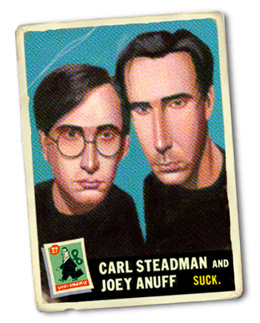 I was a one-time contributor and day-one reader of Suck, and I think Baldwin has forgotten that site founders Joey Anuff and Carl Steadman always presented it as an elaborate doublecross on readers -- a product of the same cynical dot-com hype they were shredding five times a week. Suck ran so many self-loathing critiques over the years that his rant sounds like something it would have published. Suck writers were calling themselves frauds and sellouts long before any critics cared enough to say it:
A formulaic method to success is the grail that we're all after -- from sleazy get-rich-quick schemes to 12-step programs to kick a habit that's become just a little too familiar, we can't get enough of easy, no-brainer ways to give us maximum returns for minimal effort -- that's what it's all about, isn't it?
A comment from the back of their self-authored NetMoguls card: "Are you familiar with the term 'one-hit wonder'?"
Anuff and Steadman have no control over what happens to the domain, which is registered to Lycos, the company that had a 25 percent stake in Automatic Media.
If they did, a six- or seven-figure sale to the people who've made the most of this way-nu medium -- smut peddlers -- is surely the ignominious fate they envisioned for Suck.
Feedster Contest: Music To My Ears
Workbench is dangerously close to winning an iPod in the Feedster Feed of the Year contest. I was told recently that my weblog was one of the top 10 finalists in the judging, which rates sites not for the size of their traffic, but what they do with it:
Most blog awards consist of nominations, reviews, and voting so naturally, the more popular blogs always rise to the top. Instead, a panel of independent judges rated blogs across a range of criteria, not just number of links or traffic.
Feedster is counting up to the winner one day at a time, so each morning I check the site like a 20-year-old watching the Vietnam Draft Lottery in 1969, hoping my number doesn't come up.
Four sites remain in a contest that awards an iPod Video for first place and iPod Nanos for second and third -- Grant Barrett's Double-Tongued Word-Wrester Dictionary, Andrew Moere's Information Aesthetics, the group-authored Treehugger and Me! Me! Me! Pick Me!
If the contest was played by Deal or No Deal rules, I would have panicked by now and accepted an offer of something like the Dell DJ Ditty rather than risk going home empty-handed.
Student's Little Red Hoax Circles the Globe
The Drudge Retort fell for a hoax earlier this month, passing along a newspaper's report that a college student was investigated by the Department of Homeland Security for requesting Mao Zedong's Little Red Book on interlibrary loan. The student admitted on Friday it was a little red lie.I hate falling for stuff like this, because I like to think I was occasionally listening in class when I earned a journalism degree from the University of North Texas. In hindsight there were strong reasons to be skeptical: The claim was reported by a small newspaper, the New Bedford Standard-Times, based entirely on the account of a student who asked the paper not to reveal his name.
Other suckers include Slashdot, Molly Ivins, Sen. Ted Kennedy, NewsMax and several hundred blogs.
The newspaper that originally reported the story hasn't come close to apologizing. Reporter Aaron Nicodemus blames the world for wanting to believe his story was true:
The story's release came at a perfect storm in the news cycle. Only a day before, The New York Times had reported that President Bush had allowed the National Security Agency to conduct wiretaps on international phone calls from the United States without a warrant. The Patriot Act, created in the aftermath of the Sept. 11, 2001, attacks to allow the government greater authority to monitor for possible terrorism activities, was up for re-authorization in Congress.
There was an increased sense among some Americans that the U.S. government was overstepping its bounds and trampling on civil liberties in order to thwart future attacks of terrorism. The story of a college student being questioned for requesting a 40-year old book on Communism fed right into that atmosphere.
The newpaper's opinion page apportions 100 percent of the blame to the student:
Student should be ashamed: Thumbs down for the UMass student who lied to professors and The Standard-Times about being visited by federal agents after he ordered a copy of Mao Tse Tung's Little Red Book through the inter-library loan system. This bogus story went around the nation and gave the public a false impression of our government at a time whenour government is under intense pressure to defend the homeland from terrorism and does not need the public to turn against it.
The paper continues to honor a confidentiality agreement with the student who lied to them, a journalistic practice I've never understood.
Handshake or No Handshake
NBC's web site offers a Flash version of Deal or No Deal, an odd new game show that pits a player's greed against the arithmetic mean.I've only caught a few minutes of the show, which aired last week and will be repeated Monday on CNBC, but I may start watching to see Howie Mandel not shake hands with the contestants.
Mandel's a germophobe, writes Mark Evanier:
I think it's weird that NBC has one reality show where the contestants are expected to eat rat --------- but they also have two -- this and Mr. Trump's Apprentice -- where the stars are terrified of germs. You know, Howie and Donald, touching other people is a great way to maintain good, healthy hair. Look at the difference between the scalps of Leno and Letterman.
That's a far cry from Richard Dawson, who used to grout the esophagus of every female contestant on Family Feud.
Wikipedia Needs Women
Shelley Powers believes that well-known female technologists are less likely to find themselves in Wikipedia than their male counterparts:Why are there significantly fewer women? I think one reason is that we women are taught not to put ourselves forward. Men are complimented for tooting their own horn; making known their wishes; noting their own accomplishments. Women, however, are expected to be sweet, demure, and most of all, stay ever so slightly in the shadow.
My take on her observation is that men are more strongly rewarded for being assertive, a group dynamic you can see in play often if you look for it. A few years ago I lost a bunch of weight by following Weight Watchers, and the weekly meetings I attended were an intrusion into a world that had as many males in it as an Oprah Winfrey taping. Even in a crowd that was 20-to-1 female, I was amazed at how often male dieters dominated the discussions.
(Personally, I was afraid to speak, fearing that some of the dieters starving themselves for the weekly weigh-in might had sublimated their hunger with inchoate rage.)
I'm fishing around for underrepresented subjects in Wikipedia, so I added a biography this morning for one of those overlooked technologists -- new-media guru and former Netscape exec Susan Mernit:
Susan Mernit (b. January 23) is a technology and media consultant based in Palo Alto, California and a former vice president of Netscape and America Online.
As an executive, Mernit launched several corporate media sites since introducing Scholastic Press on America Online in 1992. She developed the childrens educational site Yuckiest Site on the Internet with Jeff Jarvis and served as the editor of New Jersey Online.
She was a vice president of programming, design and production at Netscape from 1999-2001, leading a redesign of the site to coincide with the release of Netscape Navigator 6.0, and was vice president of programming at America Online from 2001-2003.
Today, she's a founding partner of the consulting firm 5ive Corp and a frequent speaker at online media and technology conferences, personally organizing the "social media" gathering BlogOn in 2004. She is a senior fellow at the Media Center, a think tank established by the American Press Institute, and an advisory board member of the the digital media archive Ourmedia.
Mernit originally pursued a career in literature, writing two collections of poetry and serving as writer-in-residence for the Teachers & Writers Collaborative. Her short story "Bella" was adapted into a TV movie in 1982. She has a bachelor of arts in English and writing from Bard College and a master's in creative writing and English literature from Ohio State University.
She was married to musician Spencer Jarrett and has a son, Zack, who attends Michigan State University.
Bibliography
- Everything You Need to Know About Changing Schools (Rosen Publishing, 1992) ISBN 0823913260
- Tree Climbing (Membrane Press, 1981) ISBN 0879240369
- The Angelic Alphabet (Tree Books, 1976) ISBN 8267436752
External links
- Mernit's personal weblog
- Her photos on Flickr
- 5ive Corp.
- Poems from Tree Climbing.
Putting together a biography based only from the information you can find on the web is an interesting literary exercise -- I once frightened people on MetaFilter by compiling one entirely from a member's comments.
The Lion, The Witch and The Arms Dealer
I took the boys last night to see Chronicles of Narnia: The Lion, the Witch and the Film Franchise We Hope Will Be a Cash Machine Like Harry Potter.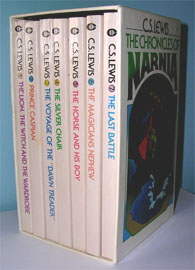 The film's a wonderfully realized vision of the book, at least through my hazy recollection of tearing through all seven novels 25 years ago in the Collier boxed set, which I've kept all of these years. But the logic of the C.S. Lewis novel makes less sense than it did when I was a child.
I don't care if they're just a bunch of dissident animals and sympathetic creatures from British folklore. They should have more sense than to create a system of government dependent upon the accidental arrival of children who will serve as monarchs without a clear line of succession.
Even worse, Narnia relies on these minors for military leadership and front-line combat, sending them into battle against such opponents as this giant minotaur.
As a child, I thought it made perfect sense for Peter, Susan, Edmund and Lucy to be equipped with swords, bows and chainmail the moment they acquiesce to the beaver's badgering and agree to overthrow the White Witch.
The second time around, I was a bit squeamish when Santa Claus showed up unexpectedly and gave Lucy two Christmas presents: a dagger and a potion to heal mortal wounds.
Santa's only word of advice before he takes his leave of the six-year-old and the rest of her newly armed siblings? "Battles are ugly affairs."
A Toast to Computer Book Authors
Whenever a new biography is added to Wikipedia, an "articles for deletion" debate is likely to happen on whether the subject is notable enough to merit inclusion.If the subject's a computer book author, you invariably get a comment from a Wikipedia editor like the one that was just made about best-selling O'Reilly author Shelley Powers:
I really don't believe that authoring a how-to technology book makes one a notable author. We might as well have articles for writers of toaster manuals.
He has a good point. I'm nine years into the profession of computer book authorship and still waiting for my first groupie. We might be the category of authors with the lowest adoring-fan to copies-sold ratio in publishing.

Social Media

Subscriptions


Blogroll
Projects
RSS Advisory Board
How to Read an RSS Feed with Java Using XOM
The RSS Advisory Board Just Turned 20
Downloading 50,000 Podcast Feeds to Analyze Their RSS
Tara Calishain Explains: What is RSS?
Be Unique And Use RSS Guid Like Everybody Else
Statistics

This blog has been published since Nov. 7, 1999 (a span of 9,807 days).
Thank you for visiting Workbench.
