RSS Board Launches Socialtext Wiki
The RSS Advisory Board now has a wiki provided by member Ross Mayfield and Socialtext.The impetus behind the launch of the workspace is to support efforts on the RSS-Public mailing list, such as software tests like one that I've been conducting to see how well aggregators can display a diaresis character.
(Loïc Le Meur has agreed to be a diacritical test subject.)
Anyone can create an account and edit pages, as long as the content's related in some form to what we're doing on the advisory board. The wiki can be used to collectively draft etiquette policies and other guidelines as they become necessary. Feel free to experiment with its collaboration tools.
Thanks, Ross!
Really Simple Syndication: The Joy of Specs
The ongoing Canterbury tale about the efforts of the RSS Advisory Board must be utterly incomprehensible to people who have enthusiastically adopted Really Simple Syndication without knowing the history of the format.Syndication is like sausage, major Congressional legislation and Bruce Jenner. You might be better off not knowing how it's made.
Dave Winer, the co-creator of RSS and the person most responsible for its widespread adoption, argues that the current version of the RSS specification must never be revised in order to protect the stability of the format:
These constraints have served us well. They have kept the platform stable, so Microsoft could take two years to adopt it from top to bottom in their Windows operating system, and not have RSS change while they did their work.
This position deserves strong consideration, though I must point out that under his leadership the board made six revisions to the specification.
If the current spec is treated as the final word on the matter, there are practical consequences to that decision for RSS software developers, publishers and users.
One of the biggest involves podcasting.
An RSS feed may carry podcasts and other media files, storing them in enclosures associated with items in the feed.
There's disagreement among developers over whether the spec permits more than one enclosure in each item. Some believe that because it doesn't explicitly forbid multiple enclosures, they're permitted. Others can demonstrate that the spec author's intent was to allow no more than one.
The publishing tools Blogware, Movable Type and WordPress all produce RSS feeds with multiple enclosures per item.
The political weblog Power Line, published with Movable Type 3.15, offers a podcast feed that includes multiple enclosures.
This feed doesn't work properly in some popular podcast-enabled RSS clients, including Bloglines, FeedDemon, Google Reader and new software being developed by Microsoft, the company whose top-to-bottom support for RSS is cited as the reason to leave the spec alone.
The preview edition of Microsoft Internet Explorer 7 only downloads the first enclosure in each item. Power Line users who listen to its podcasts with that browser must manually download the other enclosures, which removes the biggest advantage of podcasting -- instant availability of the files.
When Microsoft rolls out the browser later this year, millions of new users will be introduced to RSS and podcasts for the first time.
If no group has the authority to resolve the enclosures issue, all podcasters relying on multiple enclosures will be publishing RSS feeds that don't work for what is potentially their largest audience.
Journey to the Center of the Earth
Wired News is running my story today about the center of the world: the Shamrock "K" Horse Center near Coffeyville, Kansas.Maggie Dew, the geocacher who journeyed to the center and brought back photos, has planted a cache not far from the city at a '60s landmark called Peace Point:
Some friends and I had a little shop in downtown Coffeyville called the Hobbit Hole. We had a peace flag in the front window, and it wasn't long before someone decided to lob a brick through it. During the same period, some of my friends put up a huge peace symbol on a tall pipe on this bluff overlooking Coffeyville. It could be seen from quite a distance, and it was written up in the Coffeyville Journal. Again, in less than a week's time, someone cut it down. A piece of that pipe still sticks out of the ground today. Take a walk out to this viewpoint overlooking the town and contemplate why, to some, the concept of peace is such a fearful and loathsome thing.
The satellite photos on Google are prompting a lot of sightseeing, as I found while obsessing over Google Maps during the preparation of the story. My favorite discovery is the Palm Beach UFO.
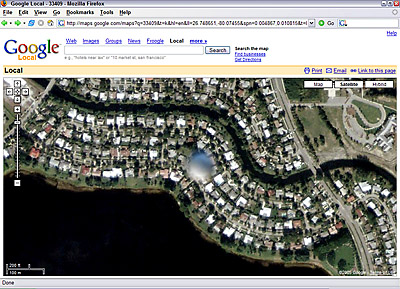
Palm Beach County has a large population of elderly residents, bringing its median age up to 42. I don't want to reach a definitive conclusion until the subject's covered by Coast to Coast, but the high-altitude weather balloon theory is no fun at all. I'm thinking aliens came back to fetch more cocoons and have non-contact laser-light sex with Steve Guttenburg's rib cage.
RSS Board Recommends the Feed Validator
The RSS Advisory Board proposal to recommend the Feed Validator has passed 8-0, with members Meg Hourihan, Jenny Levine, Eric Lunt, Ross Mayfield, Randy Charles Morin, Greg Reinacker, Dave Sifry and myself voting in favor.The Feed Validator tests syndicated documents for adherence to the specification and provides other warnings that are helpful when publishing a feed for the first time.
It supports the three formats in wide use today -- Really Simple Syndication, RDF Site Summary and Atom -- and is an open source project that takes bug reports and suggested patches from the public.
Kudos to lead developers Sam Ruby, Mark Pilgrim, Joseph Walton and Phil Ringnalda for their work the past three years on the project.
Wikipedia Fights for Prophet Muhammad Cartoons
The controversy over the publication of editorial cartoons depicting the Prophet Muhammad is playing out on Wikipedia, where an image of a newspaper page containing the cartoons has been removed eight times within the past week alone.An internal poll of Wikipedia editors strongly favored the publication of the image, which puts the online encyclopedia in the same position as media organizations that have taken criticism for reprinting them.
"Making and also looking the figures of Mohammed is forbidden," wrote one editor who called the decision to include them an insult to Islam. "Every time I enter the page I click as fastly as I can to the 'discussion' to don't see the cartoon."
Contributors to Wikipedia are 4-to-1 in favor of their inclusion. "Most of the arguments to censor this image are despicable," one stated. "It is the honour and duty of any free man to stand against such things."
Wikipedia's discussion page for the article includes a Cascading Style Sheets tip that enables users to turn off display of the image:
- You will need to be logged in as a user in order to do this.
- Open your monobook.css page, this will be User:yourUserName/monobook.css
- Add the following line: #mi{display: none;}
Reading the arguments taking place within the internal talk pages of Wikipedia gives an appreciation for the immensity of the encyclopedia's mission, which seems guaranteed to land cofounder Jimbo Wales and other participants squarely in the center of every heated political and speech controversy from now until the end of time.
Wales personally deleted the main talk page about the cartoons Feb. 1, pleading for more civility:
This is not the appropriate place for a general philosophical discussion about Islam, freedom of speech, terrorism, religious tolerance, etc. Not only is this talk page not the right place for it, Wikipedia is not the right place for it. Here, we are polite, thoughtful, smart, geeky people, trying only to do something which is undoubtably good in the world: write and give away a free encyclopedia.
Life Expectancy and Liver Cancer
My surname is uncommon enough that most Cadenheads in the U.S. are cousins, though to find a common ancestor, you often have to climb the tree until you reach a hardscrabble Civil War family in Georgia, Alabama or Texas that had umpteen children, most of which had strong biblical names like Isaiah and Levi.While egosurfing to read opinions of the RSS Advisory Board, I found a plea posted last night by a Cadenhead who fears that her 67-year-old mother's fight with liver cancer may be nearing its end:
I want to have an idea of what to expect. Liver cancer is not supposed to spread, is it? How long do patients suffer? What is my family going to have to watch her go through? We're all really scared and upset, but I think it would help us if we had an idea of how long a patient actually suffers in the end.
If anyone has experience with circumstances like that, here's the Cancer Forums signup page.
New Tool Lets You Play Around with RSS
I've added a new tool to the RSS Advisory Board site that makes it easier to test different Really Simple Syndication element and attribute values in the Feed Validator.RSS Playground uses a sample RSS document as a starting point, letting you change the values and create a new document that will remain online for 72 hours.
I used the tool this afternoon to see what the Feed Validator does when it encounters a feed containing RFC 2822 date-time values.
Because this tool's being used to support ongoing development of the proposed specification for RSS, the default values are taken from that proposal rather than the current specification.

Social Media

Subscriptions

Blogroll
Projects
RSS Advisory Board
How to Read an RSS Feed with Java Using XOM
The RSS Advisory Board Just Turned 20
Downloading 50,000 Podcast Feeds to Analyze Their RSS
Tara Calishain Explains: What is RSS?
Be Unique And Use RSS Guid Like Everybody Else
Statistics

This blog has been published since Nov. 7, 1999 (a span of 9,820 days).
Thank you for visiting Workbench.
