RSS Means Never Being Board
John Palfrey:Dave Winer:We've heard from a number of people about an uneasy (and unfounded) sense that something is happening with respect to the RSS 2.0 spec. Just by way of clarification, nothing has changed from the perspective of Harvard, which is the owner and trustee of the RSS 2.0 spec. ... While we are delighted to know that many members of the RSS community continue to work on relevant issues to move the industry along in various ways, including related to the spec itself, Harvard has no involvement with any of these efforts.
1. The spec is owned by Harvard. 2. The RSS Advisory Board, when it existed, performed a support function. Later, in case anyone was still confused, we disclaimed: "It does not own RSS, or the spec, it has no more or less authority than any other group of people who wish to promote RSS."
As a member of the RSS Advisory Board for the past 21 months and the current chair, I am surprised to learn that the organization doesn't exist.
I joined the board at Winer's invitation in May 2004, not long before he resigned.
The group operated in private without a charter, and as I said at the time, the reason I joined was to help guide Really Simple Syndication to a public, participatory model like that enjoyed by Atom and RDF Site Summary (a.k.a. RSS 1.0).
Doing anything on the board became difficult in the last half of 2005 when outside commitments kept members Adam Curry and Steve Zellers from participating, so for six months it was inactive. I served as webmaster, keeping the site free of comment spam but taking no actions regarding the RSS specification.
In January, I invited former board members Andrew Grumet, Brent Simmons, Jon Udell and Winer to a private mailing list to discuss whether it should shut down or recruit new members. The decision that came out of that list was to continue in a publicly accountable fashion, which culminated in a charter and eight new members.
Before they were asked to join, Winer told me in a Jan. 21 e-mail, "You can carry on the business in any way you want as far as I'm concerned, I just want that site, and the spec, to be left as-is. I won't even object if there's a pointer to the new site you want to start on the old one."
In part to address his concerns (and some voiced by Palfrey), I launched a new site for the board and we've been working on a newly written specification that seeks to resolve long-standing issues with RSS that make it difficult to implement, such as a lack of clarity on whether an item's description is the only element that can carry HTML. (The spec's not official -- it's published to solicit public review for at least 60 days. I encourage people who are interested in it to join the RSS-Public mailing list.)
Winer has now decided that the board doesn't exist and never had authority over the RSS specification, even though it has published six revisions from July 2003 to the present.
I don't agree, but now that the board's fully public, we're in a position to make his wish a reality.
The eight new members of the board are independent, strong-minded people who are well-respected in the syndication community. The organization has been trusted to publish the most-widely adopted Really Simple Syndication specification for three years, and I believe we should continue to do that, either by completing and adopting the proposed spec or relying on the current version.
I also think there's an opportunity for us to help improve détente among syndication developers by working with the creators of Atom and RDF Site Summary on areas of common concern such as the Feed Validator and the common syndication icon.
If we had shut down the board last month, I believe a new group would be needed to make RSS easier to implement and resolve issues with the format.
But my viewpoint's only one of nine.
If the board believes that nothing more should be done on RSS and the 2003 spec published by Harvard should be the last word on the subject, a vote of five members would close it down.
Opera Subscribes to Common Syndication Icon

Opera has embraced the common syndication icon adopted by Mozilla Firefox and Microsoft Internet Explorer, lead developer Trond Hansen announced Thursday:
Yes, we're adopting it too, and it will be in the next weekly build. Thanks to www.feedicons.com for making it so easy! Oh, and in case you haven't seen it before (what are the odds). I've attached a large version to this post which you can make love to.
The icon, which makes it easier to find syndicated content in software and web sites, has been picking up speed. Matt Brett set up the Feed Icons site in January to promote the new icon, and it already has been linked 1,700 times on Technorati.
I'd like to see the effort go further and encourage common language to make the use of RSS and Atom feeds as clear as possible:
- Call an RSS or Atom document a feed.
- Call software that periodically downloads these documents a reader.
- Use the verb subscribe to describe the process.
If conventions were adopted (and localized for each language), syndication would be a considerably easier process for millions of web users who have yet to learn about it.
When a user loads a feed in the preview release of Internet Explorer 7, Microsoft follows two of these conventions, using the following explanatory text:
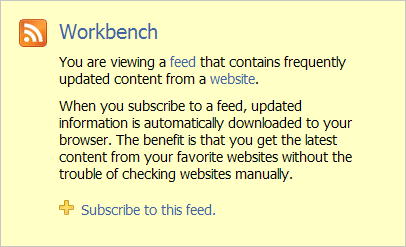
The word feed links to a Microsoft user guide about syndication.
Microsoft's doing a good job so far introducing syndication in Internet Explorer 7, but I don't like how the company uses "RSS" as a synonym for syndication. That's like calling a web page "HTML" or an e-mail program an "SMTP/POP3 client," and it's a misnomer because the browser supports Atom in addition to the two RSS formats. The technical details ought to fade into the background.
I'm a Pig at Breakfast
I turned in a feature story on Tuesday, the first paid journalism I've done for a publication since leaving the Ask Ed Brice column at the Fort Worth Star-Telegram in 2000.Like many bloggers, I've had a lot to say about journalism over the years, and I internalized the self-glorifying notion that I practice a form of it here on Workbench. But after a few days of conducting interviews, checking facts and documenting all of my sources for an editor, I was reminded of a substantial difference between journalism and blogging that I had completely forgotten.
Risk.
A blogger can feel good about his own standards of ethics and accuracy, but there's no cost for failing to meet them. Nobody gets drummed out of the blogosphere for getting something wrong, screwing over a source or writing things that bring shame upon your family. Making matters worse, your biggest mistakes may be rewarded by as much traffic as your best successes.
A working journalist has to worry about ethics and accuracy because your ass is on the line, along with that of your editors and the publication.
I can't think of a single blogger sued for libel or fired from a site over something he reported, and I've never read about one who did something fubar and thought to myself, "that poor sap will never blog again."
But as any reader of James Romenesko knows, professional journalists commit acts of career suicide on a daily basis.
There are obviously exceptions -- bloggers working for Nick Denton can blunder themselves out of a job and the journalist Susan Schmidt clearly has blackmail material over the editors of Washington Post.
To borrow one of my favorite cornpone Texas sayings, the difference between a blogger and a journalist is the difference between a chicken and a pig at breakfast.
The chicken's involved.
The pig's committed.
Turning Off a Radio UserLand Scripter
Last June, I published a 23-minute podcast of Juan Cole being interviewed on the Alan Colmes radio show.A Radio UserLand user on Comcast in Monterey, Calif., is apparently a big fan of Cole. His copy of Radio keeps requesting that 5.5-megabyte podcast over and over, as frequently as every 10 seconds. In the last week alone, he's consumed 12.13 gigabytes of my server's bandwidth by downloading the file 2,365 times.
I don't know why this is happening -- it could be a bug in Radio UserLand or a UserTalk script run amok, either by accident or by design. The fact that it's coming from a fixed IP address suggests it's not malicious.
I renamed the audio file and blocked the offending address with iptables:
The problem illustrates an aspect of Radio and the OPML Editor that casual users should keep in mind when they begin writing scripts in these programming environments. You need to know exactly what the script's doing, especially when you schedule it to run regularly.
These repeated downloads amount to a denial of service attack, and the 56 gigabytes of traffic he's consuming per month is larger than the transfer limit on many servers, subjecting the publisher to excess bandwidth charges.
If this user needs to learn how to write scripts in Radio, there's a book I can recommend.
Columnist: 'Blacks are No Longer Rioting'
In the Washington Post this morning, columnist David Ignatius makes a few jaw-dropping racial generalizations in a piece comparing Muslim outrage over the Muhammad cartoons to African-American reaction to the N word:I think the Muslim world could learn something about tolerance from African Americans. The United States still abounds with racist images, but blacks are no longer rioting in the streets or burning down buildings. ...
We haven't abolished racism, but by working honestly at the problem, we've made real progress. Along the way, we experienced rage and violence. ...
We're in the rage phase -- the part of the story where black folks are torching cities, white governors are sending in the National Guard and the problems seem insoluble.
I admire writers for discussing race, because the volatile subject's so likely to provoke people, but Ignatius blunders into it thoughtlessly here. The claim that "blacks are no longer rioting in the streets or burning down buildings" is offensively broad, and he repeats it twice. Would he write that white people are no longer lynching blacks, or qualify the statement by putting the crime on "white racists" rather than an entire group?
Additionally, his assertion that the U.S. has solved its racial problems and become a "place where black folks and white folks pretty much get along" comes only five months after Hurricane Katrina and the flooding of New Orleans, a disaster that exposed deep racial divisions that still exist in this country. A past Workbench entry on the Gretna Bridge blockade continues to draw responses like this:
You people have no idea how life in New Orleans is. Blacks feel they are owed everything, and the black government makes sure the working white man supports them. How else would lazy blacks survive. Work or leave. They refuse to work, have kids so the government pays them more, I have clients from all over the country and world, who all say the same thing, "I wasn't racist until I came here". You people should shut the ---- up unless you know the entire story, not saw cnn or heard the poor black guy tell his sad story on tv. I personally know Gretna Police Chief Arthur Lawson, he has more balls than most people in the spotlight, and is a GOD in my eyes. I love this man. What higher ground is there than the bridge? Where were they going to go? In the white mans neighborhood, where he has worked hard all his life for what he has. Stop being cowards and see the fact that blacks in New Orleans are different from blacks in other parts of the country. Thats the way it is.
Before Ignatius proclaims racial harmony in this country, he should go to Gretna and see how many people view the Katrina disaster in terms of black and white.
St. Augustine Cages Tiger
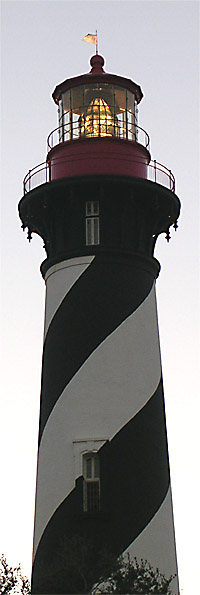
A local man in a Bengal tiger costume climbed atop the 165-foot-tall St. Augustine lighthouse Tuesday morning, stayed up there four hours and placed a 4Myduke.Com flag on a lightning rod to protest Internet pornography and publicize his children's book.
Frank Feldmann, who's selling a self-published book about Myduke the magic tiger under the pen name Dusty L. Cage, published a "Legal Defense Fund" page on his web site before storming the lighthouse:
If you are visiting this page Myduke probably needs your HELP! As you know cats, even BIG cats, get into trouble and trouble usually means LEGAL EXPENSES! That is usually what happens when someone stands up for what is right. LEGAL EXPENSES. Many Legal Expenses.
If you support Myduke in his quest for Porn and Agenda Free children's entertainment, you can help two ways. Straight out contribution or the purchase of Dusty L. Cage's books. ...
Simply put. In the society we live in, sometimes it is necessary to do things to raise attention that some may see as a nuisance. When in the battle against child porn, unnecessary violence, and popular political agendas it is at times necessary to speak out in ways that may hold a progressively uncaring public's attention.
A parents section on his site contains examples of the porn he's protesting -- sexually explicit illustrations of Disney characters, over which he's added Mickey Mouse in some places to preserve what's left of their dignity:
We together as families, I believe we can stop this. Not only for the protection of our children, but for the protection of our own childhood memories. ...Don't be mad at me for showing this, I'm risking my life to stop this. What are you doing?
Feldmann's been charged with felony burglary and possession of burglary tools over the stunt. His flag's still flying over the lighthouse.
In 2003, he rode a local carousel 52 hours and 15 minutes to support the troops, raise money for the March of Dimes and publicize his children's book.
Mark Pilgrim's Not on Board
Mark Pilgrim offers his long bet on the newly public RSS Advisory Board:I assume the group won't actually accomplish anything; they'll just stumble around like small children running with scissors to catch the short bus until they quietly disband, and we can look forward to doing all of this over again in 2 years. But in the meantime, I regard it as inevitable that the group will eventually try (and fail) to tackle every single one of these issues. (I believe Rogers once called this "the most well-researched flame on the Internet," which is about as close to a compliment as I'm likely to get from him.) But no one will actually dare to link to the article itself, and those who haven't read it (or couldn't finish it because they were too busy spitting bile at their monitor) will wonder where all these test cases came from, and why everyone seems to know so much about this ragtag collection of esoteric issues, and wouldn't it be nice if someone could write all of them down in one place, and someone will volunteer to do exactly that, except he'll want to be all clever-like and do it in OPML, and it will only validate in one of the three OPML validators, and the thread will go off on a long tangent about which validator is "correct", which will itself spawn a separate mailing list, blog, wiki, discussion forum, and advisory board to be hosted at opmlboard.org, which will fork each existing OPML validator and host it locally and then never update it, so they will slowly go out of sync with each original version, which will lead to a total of six OPML validators and a bitter Google PageRank war and lots of wringing of hands about how Google is favoring OPML validators that are not The One True OPML Validator, which is, of course, Radio.
But I'd be happy to be proven wrong.
I don't know how much the board will accomplish, and I'm reluctant to saddle the new members with my own expectations, but I'm encouraged by the early progress on a proposed specification, which if written properly ought to resolve some long-standing issues.
Ultimately, the reason I was eager to see the group go forward (and go public) is because Really Simple Syndication is a ginormously successful format that's going to become more popular after the release of Internet Explorer 7. Thousands of sites use RSS. Businesses are banking on it, including the largest software company in the world.
Considering all of that, how could anyone favor the dissolution of a group that publishes the format's specification and tries to make RSS easier for developers to support?
RSS already lost one patron when Netscape abandoned interest just as syndication was starting to take off six years ago. Losing another today, when syndication formats are about to be introduced to millions of users through Internet Explorer, doesn't make sense.

Social Media

Subscriptions

Blogroll
Projects
RSS Advisory Board
How to Read an RSS Feed with Java Using XOM
The RSS Advisory Board Just Turned 20
Downloading 50,000 Podcast Feeds to Analyze Their RSS
Tara Calishain Explains: What is RSS?
Be Unique And Use RSS Guid Like Everybody Else
Statistics

This blog has been published since Nov. 7, 1999 (a span of 9,820 days).
Thank you for visiting Workbench.
