Keep an Eye out for Hurricane Philippe
There's a new tropical depression forming in the Caribbean at latitude 13.0 north, longitude 55.0 west.Tropical Depression 17 has the potential to become Hurricane Philippe around the time it nears the islands of the Lesser Antilles on Monday, according to Jeff Masters:
TD 17 is here, and will likely be the first major hurricane of September. This storm will be with us for the next two weeks, since it is moving slowly and has a large area of ocean ahead of it. The storm is in a an environment favorable for intensification, and should be Tropical Storm Phillippe Sunday and Hurricane Phillippe by Tuesday. ...
It is impossible to say where TD 17 may go five days from now.
While looking up this depression's potential name, I found an experimental Yahoo Buzz game, where you can buy and sell fantasy shares in newsworthy and technical subjects. I now own 804 shares of Hurricane Philippe, which is Saturday's biggest gainer.
Two Americas, One Bridge
People would go up the bridge every time they lined us up for the buses and the buses wouldn't come. People in groups would go up the bridge trying to go across the river. People who had family across the river couldn't get across the river. They were not letting us out of there. -- Denise Marsh, a Convention Center evacuee interviewed on This American Life (audio attached)
For all you people who think we are races in Gretna, please leave your address, we will be glad to bus all the criminals to your home town. Lets see how you would like your house robbed, or your daughter raped, or you house burned down. ... You people in cities like Houston will be sorry you took those people in, just watch the crime rate in Houston climb, and the other cities that took them in. -- comment posted this morning on Workbench
Residents of Gretna, Louisiana, are pleased with the decision to block the Mississippi River bridge leading out of New Orleans to evacuees after Hurricane Katrina.
The Gretna city council passed a resolution Thursday supporting the police chief's decision to block the bridge.
The Los Angeles Times describes three of the undesirables kept out of the city:
Among the people trapped in the city were Sandra's son and her ex-husband, Otis, 61, a diabetic who has used a wheelchair since his leg was amputated.
Otis had gone without dialysis for five days when their sons, Otis Jr., 35, and Orrin, 34, decided to push his wheelchair down the highway in search of help. They ended up walking miles.
They were near safety that Wednesday after the hurricane -- most of the way across the Crescent City Bridge into Gretna, La. -- when an armed officer told them to turn back because Gretna officials were concerned about looting.
By the time they made it out of New Orleans, hitching a ride on a truck, the younger men's feet were bloody and covered with rashes. Otis Sr. had fallen out of his wheelchair three times while they were walking and had open wounds on his head. He was nearly in a coma.
Allegations that race played a factor in the bridge blockade are being heard by attorneys for the NAACP, President Bruce Gordon told me during a bloggers' conference call Wednesday.
Louisiana NAACP President Ernest Johnson said, "Those who had the ability to transport themselves out prior to the floods were received with open arms. It wasn't 'til the ethnicity changed that that kind of reception committee was formed."
Gretna Police Chief Arthur Lawson Jr. denies race motivated the decision.
Gretna, population 17,000, is the seat of Jefferson Parish, described in 2003 as "Louisiana's most notoriously racist parish" by the Louisiana Capital Assistance Center, a group that provides legal defense for indigent suspects in death penalty trials.
A blogger's map shows the position of Gretna relative to flooding and relief efforts staged on Interstate Highway 610 northwest of the city. The map's creator argues that the bridge route would have done more harm than good, sending people on foot further than a route along the New Orleans side of the Mississippi River.
In other news:
Gretna Mayor Ronnie Harris said his city relied on help from friends in other cities in the first harrowing days after Hurricane Katrina because no assistance from federal or state governments was forthcoming.
"We got help from people that I made contacts with, not from the bureaucracy for four or five days," he said.
"I kept trying to get the director of [Louisiana] Office of Emergency Preparedness and he never took my call. We never saw anybody from FEMA or the Red Cross," Harris said. "I understand the national media focus was on New Orleans but we had needs too."
Politics · Podcasts · Hurricane Katrina · 2005/09/17 · 11 COMMENTS · LinkHenri Bergius has incorporated code from my Weblog Pinger Library for PHP into the Midgard Content Management System.
This represents a Sally Field moment for me, the first time that any code I've written has made its way into another project thanks to an open source license. I'm going to celebrate my increased geek cred by buying something like this.
Senate Testimony Signifying Nothing

Andrew Hyman, a conservative attorney who has been promoting John Roberts vigorously since his selection by President Bush, abandoned the judge in response to his answers during the first day of the confirmation hearings:
It now appears very possible to me that President Bush has nominated a pro-Roe vote in place of an anti-Roe vote. It appears from this morning's testimony -- and I could be wrong about this -- that Judge Roberts will probably affirm the so-called right to obtain an abortion all the way up until viability, even though 72% of women in the United States have consistently said that abortion should generally be illegal months before viability.
Read the entire discussion, one of the most fascinating I've found on the Roberts hearings, and you'll find that conservatives have no more idea than liberals what we're getting for the next 30 years. With a voice as soothing as an NPR host, Roberts has shown that he's expert on constitutional law, quick-witted, and intelligent enough to give the American public absolutely no clue as to his judicial philosophy.
He's also extremely personable. After hearing his encyclopedically vague answers for three days, I like Roberts so much I resent myself for wanting to know anything about him.
Throughout the hearings, Roberts has relied often on the rationale that he can't provide his opinion on matters that might be revisited by the court. He even used it to avoid discussing Bush v. Gore, a case in which the Supreme Court explicitly stated it was not setting a precedent. Here's the exchange about the case with Wisconsin Sen. Herb Kohl:
KOHL: I asked you what your opinion of that decision was at that time.
ROBERTS: Well, that's an area where I've not been -- I've not felt free to comment whether or not I agree with particular decisions or...
KOHL: Well, it's not likely to come up again.
ROBERTS: Well, I do think that the issue about the propriety of Supreme Court review in matters of disputed electoral contests, it is a matter that could come up again. Obviously, the particular perimeters in that case won't, but it is a very recent precedent.
And that type of a decision is one where I thought it inappropriate to comment on whether I think they were correct or not.
If the nation no longer expects candor from Supreme Court justices, the Judiciary Committee should adopt the format of What's My Line?, with blindfolded senators asking a series of yes-no questions of the nominee to determine his identity. The winner could receive a federal highway named in his honor and three ethical violations to be named later.
Justice Junction, What's Your Function?
The primary job of Republicans on the Senate Judiciary Committee is to run out the clock and help John Roberts say as little of substance as possible during the confirmation hearings. Some of them are better at this than others.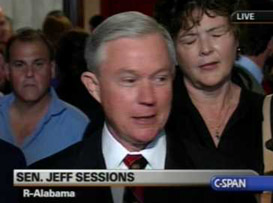
Alabama Republican Jeff Sessions used his alloted time yesterday to make Roberts walk through the process of how a case reaches the Supreme Court and becomes a decision:
SESSIONS: So the lawyers from both sides then appear before the court, over in the Supreme Court building, and they answer questions and make their presentations as to why they think the court should rule the way they would like it to?
ROBERTS: They usually get an hour for the whole case.
So each side gets a half hour and that half hour is taken up almost entirely by the justices' questions.
I hope that Sessions, the former attorney general of Alabama, will test Roberts next on the three branches of government and how a bill becomes a law.
Everyone Likes John Roberts
Republicans and Democrats alike noted Mr. Bush's shrewdness in promoting Mr. Roberts so fast. As the president put it: "For the past two months, members of the United States Senate and the American people have learned about the career and character of Judge Roberts. They like what they see." Journalists have delved deep into his closets without finding anything resembling a skeleton. Liberals find him personally likeable.
This passage from The Economist embodies the conventional wisdom on John Roberts: He's good enough, he's smart enough, and doggone it, people like him.
Though America is infatuated with the affable 50-year-old Court of Appeals judge, we're deciding whether to make a lifelong commitment here. Shouldn't we be in love with him first?
As Chief Justice, Roberts could be handed the keys to the Constitution for the next 30 years -- even longer if scientists figure out how to keep floating heads alive in jars. He may be the swing vote in deciding whether we can refuse end-of-life medical treatment, buy contraception, and bugger each other like minks in the privacy of our homes.
During a conference call I joined with other liberal bloggers last night, Sen. Ted Kennedy made the case for roughing up Roberts during the nomination hearings.
"Our Republican colleagues seem to be working from the same playbook ... he doesn't have to answer any questions," Kennedy said. "We can only wonder why they don't want us to know about him."
Tough questions will be regarded as unfair by conservatives, aside from the small number who join Ann Coulter in believing that Roberts is a stealth nominee as likely to be a Souter as a Scalia.
Though it might make Sen. Coburn cry, Democrats must stand in strong opposition to Roberts until he demonstrates that he deserves the job. There's only one correct answer to the question, "do Americans have a right to privacy?," and it isn't "I won't tell you because I want it to be a surprise."
In 1928, Justice Louis Brandeis was alone on the Supreme Court in believing that the government could not wiretap its citizens without a warrant, writing in dissent:
The makers of our Constitution understood the need to secure conditions favorable to the pursuit of happiness, and the protections guaranteed by this are much broader in scope, and include the right to life and an inviolate personality -- the right to be left alone -- the most comprehensive of rights and the right most valued by civilized men.
We live in the future predicted by Brandeis, who recognized that "the progress of science in furnishing the government with means of espionage is not likely to stop with wire tapping." Roberts must demonstrate, without equivocation, that he will affirm the right of Americans to be left the hell alone.
Anyone who would give him the benefit of the doubt -- in deference to President Bush -- should ask themselves whether an administration that believed Mike Brown could lead the country through disaster has any idea what it's getting in John Roberts.
Oklahoma Senator Cries Justice
Freshman Sen. Tom Coburn of Oklahoma cried during his opening remarks at the Supreme Court confirmation hearings for John Roberts, which you can see on C-Span (RealPlayer link), right around the time he delivered this passage:The opportunity to sit on this committee at this time in our nation’s history will be among my most important tasks as an elected official. When I ponder our country and its greatness, its weaknesses, and its potential, my heart aches for less divisiveness, less polarization, less finger pointing, less bitterness and less mindless partisanship, which, at times, sounds almost hateful to the ears of ordinary Americans.
Coburn's an odd bird in the Senate, a practicing family physician and rigid social and fiscal conservative who once used his Judiciary Committee seat to tout breast implants:
If you have them, you're healthier than if you don't. That is what the ultimate science shows. ... In fact, there's no science that shows that silicone breast implants are detrimental and, in fact, they make you healthier.
I don't know what he has to cry about, with two seats on the Supreme Court in the easy reach of the Republican majority in D.C. Unless Roberts forgot to tell anyone he murdered a series of drifters along the Potomac in the '80s, the guy seems like a lock for the chief justiceship.
My fellow Democrats are the ones who should be crying.

Social Media

Subscriptions

Blogroll
Projects
RSS Advisory Board
How to Read an RSS Feed with Java Using XOM
The RSS Advisory Board Just Turned 20
Downloading 50,000 Podcast Feeds to Analyze Their RSS
Tara Calishain Explains: What is RSS?
Be Unique And Use RSS Guid Like Everybody Else
Statistics

This blog has been published since Nov. 7, 1999 (a span of 9,807 days).
Thank you for visiting Workbench.
