Linger, Oh Linger, Heffelfinger
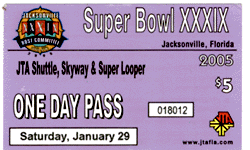
The highlight of attending NFL Experience, the Super Bowl event near Jacksonville's Alltel Stadium, was seeing Hall of Fame exhibits on loan from Canton.
Until I saw the Birth of Pro Football display, I didn't know the first pro player had the Dickensian name of Pudge Heffelfinger.
A standout at Yale, in 1892, Heffelfinger earned $500 ($10,200 in today's dollars) to play one game as a ringer for the Allegheny Athletic Association, a cheat that wasn't confirmed until 70 years later.
He was the first pro, the first contract holdout, and the first Maurice Clarett, leaving school to play for independent clubs like Allegheny. Yale fans tried in vain to convince him to stay with the odd chant "linger, oh linger, Heffelfinger."
Read more on the event from David Knighton, who was also there on Saturday and found something I wish I had seen: Pat Tillman's locker.
Podcast Support in Weblog Pinger
I have updated Weblog-Pinger, a weblog update notification class library for PHP, to support podcasting.When a new weblog entry contains an audio enclosure, you can ping Audio.Weblogs.Com, which in turn notifies a lot of services that monitor the site, such as the podcast directory GigaDial.
One gotcha for anyone else working on Audio.Weblogs.Com notification: the site's XML-RPC server is at audiorpc.weblogs.com, not audio.weblogs.com, which I finally discovered when I read the documentation.
Update: Referring to this code as my pinger sounds disturbingly like my twanger.
Democratic Podcast: Long Road Ahead in Iraq
This week's Democratic response to the presidential radio address was delivered by Rep. Ike Skelton of Missouri.Skelton's a good choice to speak on the weekend that elections occur in Iraq, because he was one of the first in Congress to recognize that the Bush administration's planning for post-war Iraq was not sufficient to the extreme difficulty we would face.
He wrote letters to President Bush in September 2002 and a few days before the war began, and in the first warned of many problems that continue to hound the American effort to stabilize the country:
Planning for the occupation of Germany and Japan -- two economically viable, technologically sophisticated nations -- took place well in advance of the end of the war. The extreme difficulty of occupying Iraq with its history of autocratic rule, its balkanized ethnic tensions, and its isolated economic system argues both for careful consideration of the benefits and risks of undertaking military action and for detailed advanced occupation planning if such military action is approved.
Specifically, your strategy must consider the form of a replacement regime and take seriously the possibility that this regime might be rejected by the Iraqi people, leading to civil unrest and even anarchy. The effort must be to craft a stable regime that will be geopolitically preferable to Saddam and will incorporate the disparate interests of all groups within Iraq -- Shi'a, Sunni, and Kurd. We must also plan now for what to do with members of the Baath party that continue to support Saddam and with the scientists and engineers who have expertise born of the Iraqi WMD program.
The transcript of his radio speech on Saturday:
Good morning.
I'm Congressman Ike Skelton of Missouri, the ranking Democrat on the House Armed Services Committee.
Tomorrow the Iraqi people will hold free and fair elections. Despite a number of serious mistakes by the Bush administration along the way, these elections are both the culmination of the progress we've made and a critical reminder of how far we have left to go.
The United States has made an extraordinary commitment in Iraq because the price of failure there is unacceptable. The fact that the Iraqis are holding elections is an accomplishment. It's a testament to the sacrifice, the professionalism and the courage of the 150,000 American and coalition troops who are backing the Iraqis' desire for self-determination and whose presence in Iraq will be necessary for some time to come.
Despite the best efforts of our troops and their Iraqi counterparts, Iraq still faces a violent and persistent insurgency fueled, in part, by economic disorder and ethnic division.
When the elections are over, the outcome will likely not be completely representative of all ethnic and religious groups. The Shia will likely control a significant majority of assembly seats with considerable Kurdish participation. The Sunnis, on the other hand, are likely to be under-represented and may denounce the legitimacy of the new government.
If they do, it will be tempting to question what we could have done differently for the last two years that would've yielded a better outcome. What if the United States hadn't disbanded the Iraqi army? What if the administration had listened to commanders like former Army Chief of Staff General Eric Shinseki who called for a larger force for post-war stabilization? What if the reconstruction funds appropriated by Congress had been spent more quickly to provide more economic opportunity for the average Iraqi?
I raised questions such as these and others before the war started in two letters to the president. These are critical questions, ones the administration should've considered before involving us so deeply in Iraq.
But now we must use the elections as a building block for a new, permanent representative form of government in Iraq. These elections are only the next step toward that goal.
This new transitional government must then draft a constitution, hold new elections and find a way to bring those disaffected by the elections, particularly the Sunnis, into the political process. This will be a challenge, but one that can and must be accomplished.
At the same time, we must continue to build up the Iraqi security forces. But we must not be lulled into a false sense of confidence by the large numbers of police and soldiers the Bush administration suggests have been trained.
While the majority of Iraqis who are serving are doing so bravely, there are still only a small number of fully capable forces. They will continue to rely on the American military for advice and support for the foreseeable future.
Providing capable security forces loyal to the Iraqi government is a long-term effort. It's a critical piece of the success of the government there and of the eventual withdrawal of our troops.
On Iraq's election day, all who support freedom should stand in support of the free Iraqis who will help choose a government. It's a great day for many. We must also continue to thank and support our troops, who have helped make these elections possible.
But we must be under no illusions about the outcome of these elections and the amount of hard work yet to come. Iraq may yet become a viable representative government, but we still have a long, long, hard way to go.
I'm Congressman Ike Skelton of Missouri. Thank you for listening.
Politics · Podcasts · 2005/01/30 · 1 COMMENT · LinkMark Evanier on Johnny Carson
The comic book and TV writer Mark Evanier writes News From Me, a great pop culture weblog that has been wall-to-wall Johnny Carson for days.
He appears to have found every interesting retrospective and trivial tidbit about Carson in the pro and online media, adding some of his own observations:
I met Carson three times, I think, plus he called me once on the phone after his retirement to thank me for some information I'd relayed to his secretary. He was always disarmingly gracious. People called him cold and impersonal off-camera, but I think that was a bum rap. He simply could not be friendly with all the people who wanted to be his buddy and, like many performers, coped with the onslaught by erecting fences. One of his associates told me that post-abdication, Johnny became a much happier and friendlier person because he was no longer suspicious that everyone he met was angling to get something out of him, especially a Tonight Show appearance.
In the mid-'90s, I had a great time interviewing Evanier and cartoonist Sergio Aragones at the Dallas Fantasy Fair for either Wizard Magazine or the Comics Buyer's Guide, writing about Groo and The Mighty Magnor.
Reading his weblog is a lot like that interview, except that he isn't pausing every 20-30 seconds for an adoring fan's autograph request and I'm not furiously taking notes.
Tony Kornheiser vs. Jacksonville
Tony Kornheiser wrote a column in the Washington Post ripping Jacksonville as a Hooters-loving, foul-smelling, remote city of doublewides that only got the Super Bowl because Tuscaloosa was booked:Jacksonville is where Pat Boone was born (sometime around the Martin Van Buren presidency), and where the Southern hair band .38 Special got together. Somehow it doesn't sound like hip-hop. It's more like I-Hop.
As a seven-year resident, I'm more offended by Kornheiser's laziness than anything he wrote about Jacksonville (though he should have included St. Augustine along with No. 17 at Sawgrass as the best perks of living here).
A recent Slate article maligned Kornheiser as one of the phone-it-in sports columnists who has been ruined by TV gigs. His column hasn't quoted a single source in four months, according to Slate, and you'd be hard-pressed to find anything resembling a work ethic in his anti-Jacksonville rant.
Kornheiser didn't even bother to skim the Super Bowl XXXIV Media Guide, where he could have found four much better local targets for ridicule: We gave the world Lynyrd Skynyrd, Limp Biskit, Slim Whitman, and David Hasselhoff.
RSS Begat RSS Begat RSS
Sean Palmer and Christopher Schmidt have released a new draft of RSS 1.1, an independent effort to replace the RDF-based syndication format RSS 1.0.When I covered this subject originally, the spec's subtitle -- which dubbed it an "initial draft" -- threw me off about how long it has been under development.
As the Rough Guide to RSS 1.1 explains, Palmer has been working on his proposal since at least September 2002.
I don't heart RDF, so I have no opinion on whether 1.1 should replace 1.0. I just hope that if Palmer and Schmidt cannot ultimately reach an agreement with the RSS-DEV Working Group to mothball 1.0, they will withdraw their spec rather than put three active, competing RSS formats in circulation.
The Lord Works in Mysterious Weblogs
Two years ago, Atlanta Journal-Constitution reporter Ron Martz was embedded as a journalist in Iraq when two soldiers travelling with him were shot. He wrote a first-person column that thanks God for providing him with human shields:I prefer to believe it was the hand of God that put them there, one behind me, one to my left. They were there to protect me. ...
Had they not been there, I most likely would not be now typing this.
Less than 30 minutes after the two soldiers joined me, both were wounded by bullets that could have hit me. The soldier behind me was hit in the left wrist and the left eye by a bullet that struck the side of the armored personnel carrier and shattered. A bullet hit the soldier to my immediate left in the right arm, just a few inches from my left arm. The bullet broke his arm, entered his body just below his armpit and came out his back.
This kind of reductive, God-picked-sides reasoning creeps me out, whether it's a journalist crediting God for bullets hitting someone else or a quarterback who thanks God in victory but never makes Him catch Hell in defeat.
Because I leave comments open on Workbench, the discussion of Martz's column has become a debate between his current and former wives, now that Cynthia Martz has dropped by:
Mary Warren is Ron Martz's current wife. No wonder she supports him! As his ex-wife of 25+ yrs. I think I know Ron Martz a bit better.
Though I don't know which one is the better authority on Martz, I know who to thank for sending Cynthia to my weblog.

Social Media

Subscriptions

Blogroll
Projects
RSS Advisory Board
How to Read an RSS Feed with Java Using XOM
The RSS Advisory Board Just Turned 20
Downloading 50,000 Podcast Feeds to Analyze Their RSS
Tara Calishain Explains: What is RSS?
Be Unique And Use RSS Guid Like Everybody Else
Statistics

This blog has been published since Nov. 7, 1999 (a span of 9,808 days).
Thank you for visiting Workbench.
