National Lampoon's Nuclear Family Vacation
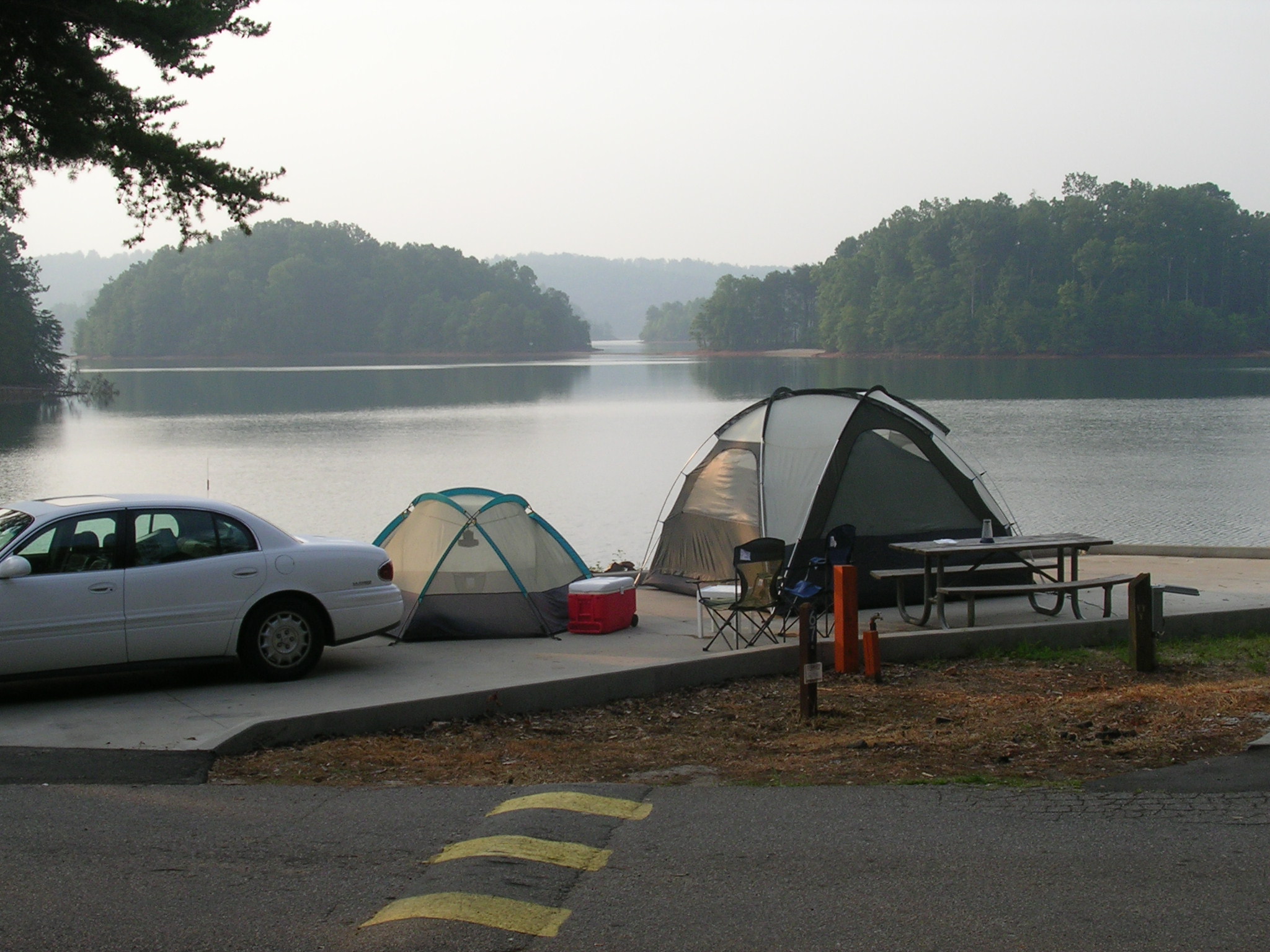
I'm writing this afternoon from the shore of Lake Keowee, an incredibly beautiful man-made lake in South Carolina.
Also on the water's edge: Oconee Nuclear Station, a massive three-reactor nuclear plant that needed the 18,500-acre lake as a source of cooling water. I haven't figured out yet whether I'm downwind.
I spent some time yesterday in a ginormous lakefront home, one of many I've seen here that appears newly built. The area -- not far from Clemson University -- contains some of the most expensive real estate in the state, which makes me wonder whether catastrophic nuclear disaster that renders the region uninhabitable for decades is one of the risks a realtor is expected to disclose. The plant went online in the early '70s with the same reactors as Three Mile Island. The lake flows atop a historic British fort and sacred Cherokee sites and was originally promoted by community leaders under the slogan "Oconee: Arrowheads to Atoms."
The people who live here "have developed an easy peace with the plant," according to one media account:
"We realize that it's here, and we know that there's always potential risk, but we also ride Harleys and there's a risk involved in that," said Kenneth Klein, 58, who moved to Lake Keowee in 2003 from Ohio.
Velvet Turman shares her sunset views on Lake Keowee with a sidedoor shot of the Oconee Nuclear Station.
Since moving to the lake four years ago, she says she's made peace with the plant knowing she is downwind and out of luck if something were to happen.
"It's in the back of my mind," said Turman. "You have a plan in your mind of what you're going to do if something happens, but you just cannot live that way. You just look at the lake -- it's beautiful -- and just go on."
I don't ride Harleys, but as I sit here and weigh the picturesque natural setting against the risk we might need to flee in terror at a moment's notice to avoid certain doom, I'm tempted to think it's a fair trade.
Mr. Hasselhoff, Tear Down That Wall
ABC News:[David] Hasselhoff enjoys cult status across Europe. This is most marked in Germany, where his 1989 album, Looking for Freedom, topped the charts for three months. Two years ago, Hasselhoff expressed disappointment that he was not recognized as having helped end the Cold War through his music.
We Enjoyed the Space Shuttle a Lot
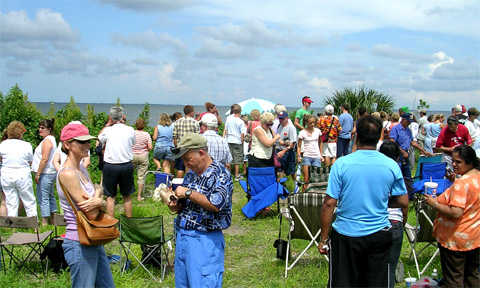
This picture was taken on Saturday in Titusville, Florida. If you look closely, you'll see the space shuttle not taking off in the background as thousands of people watch with excited anticipation along the banks of the Indian River, 19 miles across the water from the launch pad at the Kennedy Space Center.
I'm standing in a field on U.S. 1 just south of the Miracle City Mall, which the Unofficial Space Shuttle Launch Guide recommends as one of the best places to not see the shuttle take off:
If you can't get a launch pass I suggest you come to Titusville. Go east on State Road 50 from I-95, to US-1. Go north on US-1 to the "Miracle City Mall" at Harrison. Park somewhere north of this spot. Anywhere north along highway 1, or east (as far as you can) along highway 406 (402) is good (specifically Sand Point Park), just as long as you can see the VAB and don't have trees blocking the view.
Because another disaster would mean the end of the program, I dragged the kids on one of those "memory of a lifetime" moments when parents force their children to enjoy something under protest, like the time in 1981 my siblings and I were subjected to a live performance of the Gatlin Brothers.
Traffic was horrible on Interstate 95 between the scheduled launch, the Pepsi 400 race in Daytona and July 4 weekend vacationers. After the shuttle was declared a no-go because of gathering storm clouds, the three-mile drive back out of Titusville took an hour.
The family will never forget the time we spent six hours in the car to stand spend 45 minutes in a weed-filled vacant lot.
On Sunday, we saw the launch from Butler Beach south of St. Augustine, which looked like a lot like this picture from Canova Beach to the south of the cape. This was a thrilling experience that left hundreds of beachgoers awestruck -- especially if miraculous feats of human engineering make you weepy.
But next time around, I'm going to get close enough for the launch to shake loose a few fillings.
Joe Trippi on Jerome Armstrong
In today's New York Post, former Howard Dean campaign manager Joe Trippi throws Jerome Armstrong and Markos Moulitsas under the bus:Some Dems suspect [Mark] Warner fears ditching Armstrong would spark rage from his ex-business partner, Markos Moulitsas-Zuniga of the Daily Kos Web site, who's had nice things to say about Warner so far.
Armstrong and Kos are often touted as Internet wunderkinds in the 2004 Howard Dean campaign -- but Dean campaign manager Joe Trippi and top aide Kate O'Connor say it ain't so.
Trippi said Armstrong's role was "mostly to help placing our blog ads for $3,000 a month" and "Markos had almost nothing to do with the campaign."
Both Trippi and O'Connor -- while often at odds in the Dean campaign -- agreed that contrary to the Kos myth, Dean's real Internet stars were Nicco Malley, Mat Gross and Zephyr Teachout.
Trippi also said that Armstrong never disclosed his SEC woes when he was hired in June 2003 -- when the SEC probe was well under way, saying: "It was never disclosed to me."
Trippi, who has not discussed this situation on his blog, doesn't sound thrilled about being kept in the dark about Armstrong's SEC problems.
Update: I can't reconcile these quotes with Trippi's lavish praise for Armstrong and Moulitsas on MyDD this afternoon unless he has an evil simulacrum.
Chris Bowers Fights Poverty on MyDD
A rant by Chris Bowers won't help counter the accusation that Daily Kos-affiliated bloggers select candidates and causes in exchange for financial support. In a post describing his struggles to make ends meet while he's publishing MyDD and building the "netroots," Bowers tells this to progressive donors and organizations:Find some way to support bloggers, or stop asking us to support you. I have been working on the problem of getting more money to bloggers for over a year now. The biggest obstacle I see to it is that progressive donors and progressive organizations are worried that if they fund bloggers, bloggers will eventually say something "crazy," and the organizations and donors in question will end up looking bad. Fine. If that is their rationale, I can live with that. However, don't then go and tell bloggers that they should stop criticizing Democrats and progressive orgs whenever Dems and progressive orgs do something stupid. If you think we are useful, but generally too unstable to deserve regular funding, don't expect us to be quiet when Democrats and progressive organizations do things that make us mad. Don't think you can keep us in relative poverty because you don't like some of the things we say, but also think that we should shut up when we don't like what you say or do.
I'm trying not to be cynical here, but the quid pro quo in the preceding statement should be obvious to even the most fervent Kossack: Pay up if you expect us to shut up when you screw up.
Though his description of $40,000 a year as "relative poverty" is asking for trouble, Bowers has proven value as a liberal fundraiser. The netroots donation page on ActBlue, which he administers with Markos Moulitsas and two other bloggers, has pulled in $225,000 from 3,000 individual donors for 12 Democratic candidates. Factor in follow-up donations and four more months, and they could foreseeably make a seven-figure impact on the mid-term elections.
But Bowers, like Moulitsas, doesn't seem to recognize the risk he faces by tying his activism so closely to his capitalism. If people start to believe that his political positions can be bought, his support will sink faster than one of Jerome Armstrong's favorite stocks.
Warren Buffett Won't Spoil His Kids
Jacob Weisburg of Slate has written a nice fan letter to Warren Buffett for giving bajillions to charity, but he gets carried away at one point:There's a human and personal dimension to this as well: Buffett didn't want to cripple his own children by raising them to expect a free ride. As he pointed out in response to a question Monday, people at his country club who complain about the debilitating effects of welfare should recognize that they're creating a cycle of dependency by giving their own kids "a lifetime supply and beyond of food stamps." Buffett has followed through on his beliefs. While he endows the philanthropic work of his children, he doesn't plan to leave them great personal wealth. One of his aphorisms is that you should leave your kids enough to do anything, but not enough to do nothing.
Buffett's children Susie, Howard and Peter range in age from 48 to 52. It's a little late to worry that they'll grow up to be slackers.
The Head of the Anglican Church
Times are tough these days for the Anglican Church. Not only are they considering a schism with their American churches to get the gay out, but this Reuters photo indicates that their leader, the Archbishop of Canterbury, is a disembodied head.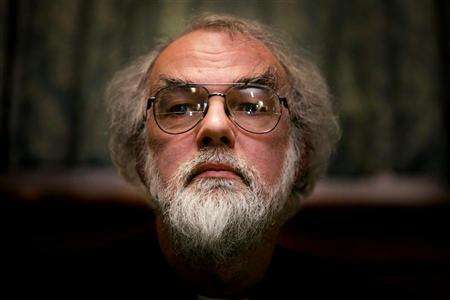
That guy scares the hell out of me.

Social Media

Subscriptions

Blogroll
Projects
RSS Advisory Board
How to Read an RSS Feed with Java Using XOM
The RSS Advisory Board Just Turned 20
Downloading 50,000 Podcast Feeds to Analyze Their RSS
Tara Calishain Explains: What is RSS?
Be Unique And Use RSS Guid Like Everybody Else
Statistics

This blog has been published since Nov. 7, 1999 (a span of 9,807 days).
Thank you for visiting Workbench.
