The Seminal Moment at the Academy Awards
I watched the Oscars last night even though I haven't seen a single film for which an actor, director or screenwriter was nominated. I have to go all the way down the list to "best achievement in makeup" before reaching a winner that I've seen, the Chronicles of Narnia.
I had the same experience with musicians at the Grammys and TV actors at the Emmys. At some point raising young kids and working obsessively have robbed me of all pop culture that isn't aimed at children. I was more excited to see Chicken Little and Abby Mallard present an award than any of the big winners.
This lack of entertainment knowledge could have been a good thing, but I took all of that empty space in my brain and filled it with the minutiae of blogging. I can't wait to find out what Joshua Micah Marshall and Jason Kottke wear to the Bloggies. If Mark Nottingham and Robert Sayre don't win for "best achievement in specification" it's a complete traveshamockery.
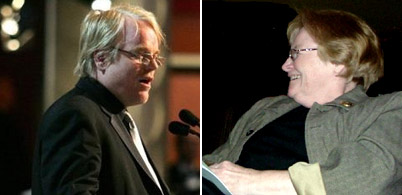
My favorite moment last night was best actor Philip Seymour Hoffman making the capstone of his acceptance speech a thank you to his mother for raising four children on her own. My parents divorced and primary custody went to my mother, so I go blubbery whenever someone with an award in his hand praises mommy.
Hoffman's mother Marilyn O'Connor is a family court judge in New York, where she issued one of the most controversial rulings in a custody case in state history. In 2004, she ordered a homeless drug-abusing couple not to have any more children until they were capable of regaining custody of the four they already had:
It is painfully obvious that a parent who has already lost to foster care all 4 of her children born over a 6-year period, with the last one having been taken from her even before she could leave the hospital, should not get pregnant again soon, if ever. She should not have yet another child which must be cared for at public expense before she has proven herself able to care for other children. The same is true for the father and his children. As to both parents, providing care for the children includes providing financial support. This is a practical, social, economic and moral reality. In effect, Bobbijean was born to a "no-parent family". She is for all practical purposes motherless and fatherless. This is not acceptable.
Support the Common Feed Icon
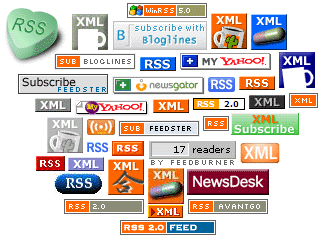
A recent Yahoo study reported that four percent of Internet users have jumped on the RSS bandwagon and begun subscribing to syndicated feeds. Considering the number of ways that web publishers show their readers they offer feeds, it's amazing we've gotten that many:
In an effort to make the concept of syndication easier for mainstream users, the next versions of the Internet Explorer and Opera browsers will identify RSS and Atom feeds with the same icon used in Mozilla Firefox. Since the market share of these browsers tops 95 percent, the icon will become the de facto standard for syndication overnight when the next version of Microsoft Windows comes out later this year.
The common feed icon has been adopted by hundreds of web sites in the last 60 days. I've been experimenting with it on Workbench and like the results.

In October, Jane Kim of Microsoft's Internet Explorer team explained what they were looking for when selecting a feed icon for the browser:
- It conveys the important attributes of feeds: newness, activity, subscription, and continual information.
- It builds on the most consistent and identifiable element used to represent feeds today: the orange rectangle.
- It avoids the use of text. Icons that have text do not generally work well for a global audience. For example, an icon with the text "FEED" may be cryptic to users whose primary language is non-Latin based. Text is very important to support an icon (in tool-tips or accompanying text). In English, we will be using the verb "subscribe" fairly widely whenever text is appropriate.
Microsoft ultimately chose Stephan Horlander's Firefox icon -- with permission -- and will use it in all of its software.
The RSS Advisory Board should officially support the common feed icon, adopting the symbol on its own site and encouraging its use on web sites, browsers, and syndication software.
Additionally, the board should encourage web publishers to use the icon on any feed, regardless of whether it employs Atom or the two formats that call themselves RSS: RDF Site Summary and Really Simple Syndication.
As technology reaches mass adoption, the technical details that matter so much to dorks like me fade into the background. This is already beginning to happen with syndication, in spite of several years of "tastes great/less filling" between advocates of different formats.
In Internet Explorer 7, two words are completely absent from all places where Microsoft tells users how to read their favorite web sites using syndication -- RSS and Atom:
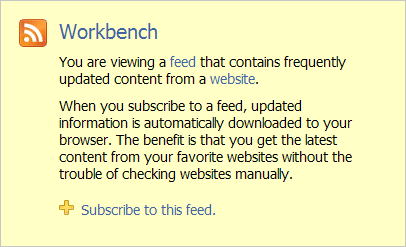
The benefits of syndication are still a hard sell for non-technical people, seven years after Dan Libby of Netscape published the first format called RSS. The use of a common icon and jargon-free language like "subscribe to a feed" have the potential to make things considerably easier.
Update: I created the RSS icon collection graphic used in this weblog entry, which is available for reuse under the terms of the Creative Commons Attribution/Share Alike license.
Looking for Détente in Really Simple Syndication
Just how many types of anxiety are there, anyway? I got to thinking about this as I read a blog that mentioned "RSS Anxiety." For those of you who have not yet come face-to-face with this little acronym, it stands for Real Simple Syndication and it spreads whatever you want all over the internet, virtually creating an immortal life all its own.
Can you kill an idea once it is out on the internet? No. Can you try to correct it? Yes, but you'll never accomplish this goal. -- Patricia Farrell, author of How to Be Your Own Therapist
Earlier this week, the Press-Enterprise newspaper of Riverside, Calif., ran a business story about an industrial zone six miles from the border of North and South Korea that seeks to strengthen ties between the bitter, long-warring rivals.
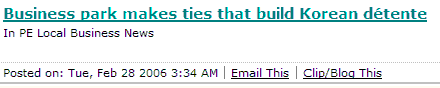
The newspaper gave the article the headline, "Business park makes ties that build Korean détente."
The word détente is one of many in English that includes a diacritical mark, a symbol such as an accent, cedilla or diaeresis.
The paper included the story in a Really Simple Syndication feed. If the editors take a look at how the headline appears in some of the leading RSS software, they'll discover one of the unfortunate realities of working with the format:
RSS does not allow détente.
The Press-Enterprise gave the headline the following formatting:
<title>Business park makes ties that build Korean d&eacute;tente</title>
The "d&eacute;tente" part is an attempt to get an RSS reader to produce the output "détente". The "é" in détente is an acute accent diacritical mark, and one way to write one on the web is by using the HTML entity é.
The following screen captures show how this headline appears in eight highly popular RSS readers and web browsers:
Bloglines:
BottomFeeder 4.1:

FeedDemon 1.5:
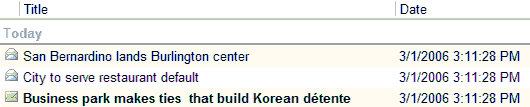
Microsoft Internet Explorer 7:
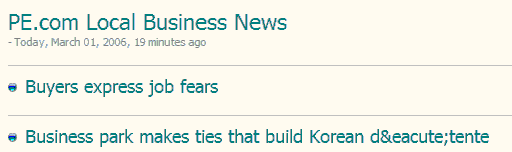
Mozilla Firefox:

My Yahoo

Newsgator Online:
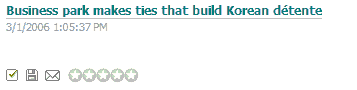
Opera 9:

As you can see, five of the eight display détente and the other three display "détente," including the two most popular web browsers on the planet. The difference occurs because the first group expects an RSS item's title to contain HTML, while the second group expects it to be plain text.
The simplest conclusion is that one group's not implementing the RSS title element properly, but there's nothing simple about the issue in the current specification. The spec states that an item's description can be HTML, but it doesn't state whether any other elements can do likewise.
One section of the draft specification attempts to solve the problem in this manner:
For all elements defined in this specification that enclose character data, the text must be interpreted as plain text with the exception of an item's description element, which must be suitable for presentation as HTML.
Dave Winer declared today that the war to clarify the spec is over and everybody won:
We live with the imperfections of RSS 2.0, because that's the way life is. Nothing and no one is exactly as we'd like them to be.
If that's supposed to be the final word on RSS, can somebody tell me how to build détente?
Name All Five Freedoms
In a telephone poll of 1,000 Americans reported by the BBC, 22 percent could name all five Simpsons but only 1-in-1,000 could name all five freedoms delineated in the First Amendment.I'm curious to see whether weblog readers are smarter than telephone owners.
Without cheating, use the comments of this entry to name all five freedoms.
I'm already on record with my guess on the Drudge Retort, and I got three out of five, leaving off one that's an extreme personal embarrassment.
One of the winners will be randomly selected to receive a pair of Cordarounds, the world's first horizontal corduroy pants, on the condition that he or she agrees to model them for Workbench and write a weblog entry on what it's like to exercise your freedom of pantaloons.
Damon Wayans Makes His Mark
New York Daily News columnist Stanley Crouch blasts Damon Wayans' attempt to trademark the word "N---a" for a clothing line and other uses, a story I covered for Wired News:He wants to put it on apparel and whatnot. So far, he has not been successful but one can imagine young American kids wearing that word emblazoned on clothes and listening to rap "songs" in which the N-word frequently appears, in conjunction with "bitches" and "hos," among other denigrations.
Of course, there is a defense. One Hollywood Negro said that "Damon is no fool. He might be pulling a Brer Rabbit move that would mean that he would take control of the word and make everyone pay to use it."
I responded rappers and others would merely put the cost in the budget.
An interesting discussion of the issue is taking place on the black entertainment site ConcreteLoop, where some fans are also hoping Wayans did it for non-commercial reasons:
we throw that word around like crazy. including me. it is a part of our lingo. no matter the coast or geographic location we use n---a scandolously. this may be a ploy to have us take a very close look at ourselves.
Response to Brad Feld
Brad Feld of Mobius Venture Capital recently made public an e-mail he sent me with suggestions for the RSS Advisory Board.Here's my response, which I also e-mailed to Feld, with some relevant hyperlinks added:
From my perspective, the purpose of the RSS Advisory Board is always open to reconsideration. This is a three-year-old organization that has been operating in public for one month. We've just begun hearing from RSS developers, publishers and executives in significant number.
I think the best way forward for the board is to keep doing exactly what the organization did under Dave Winer's leadership -- support developers, publish supplementary documentation, and clarify the RSS specification without changing the format.
Other members may decide to support his current position, which if I understand it correctly, calls for the existing RSS specification never to be edited again.
Changing the focus of the board from RSS to syndication might ease some contentious debate in the RSS community, but it wouldn't address long-standing questions for developers implementing the current specification.
There are significant aspects of RSS that lack clarity in the specification. How many podcasts can an item contain? What RSS elements can carry HTML? How does an RSS aggregator turn relative URLs into full URLs?
The proposed specification currently under draft at the RSS board's site is an effort to resolve questions like these, not change the format or create a new format that would raise the implementation cost of syndication for everyone.
If the spec reaches a vote at some future date and is rejected by the board -- or the board votes at any time to cease work on it -- I'd remove the spec from publication and pursue a "best practices" document or another method to address the situation.
RSS Board Launches Socialtext Wiki
The RSS Advisory Board now has a wiki provided by member Ross Mayfield and Socialtext.The impetus behind the launch of the workspace is to support efforts on the RSS-Public mailing list, such as software tests like one that I've been conducting to see how well aggregators can display a diaresis character.
(Loïc Le Meur has agreed to be a diacritical test subject.)
Anyone can create an account and edit pages, as long as the content's related in some form to what we're doing on the advisory board. The wiki can be used to collectively draft etiquette policies and other guidelines as they become necessary. Feel free to experiment with its collaboration tools.
Thanks, Ross!

Social Media

Subscriptions

Blogroll
Projects
RSS Advisory Board
How to Read an RSS Feed with Java Using XOM
The RSS Advisory Board Just Turned 20
Downloading 50,000 Podcast Feeds to Analyze Their RSS
Tara Calishain Explains: What is RSS?
Be Unique And Use RSS Guid Like Everybody Else
Statistics

This blog has been published since Nov. 7, 1999 (a span of 9,807 days).
Thank you for visiting Workbench.
