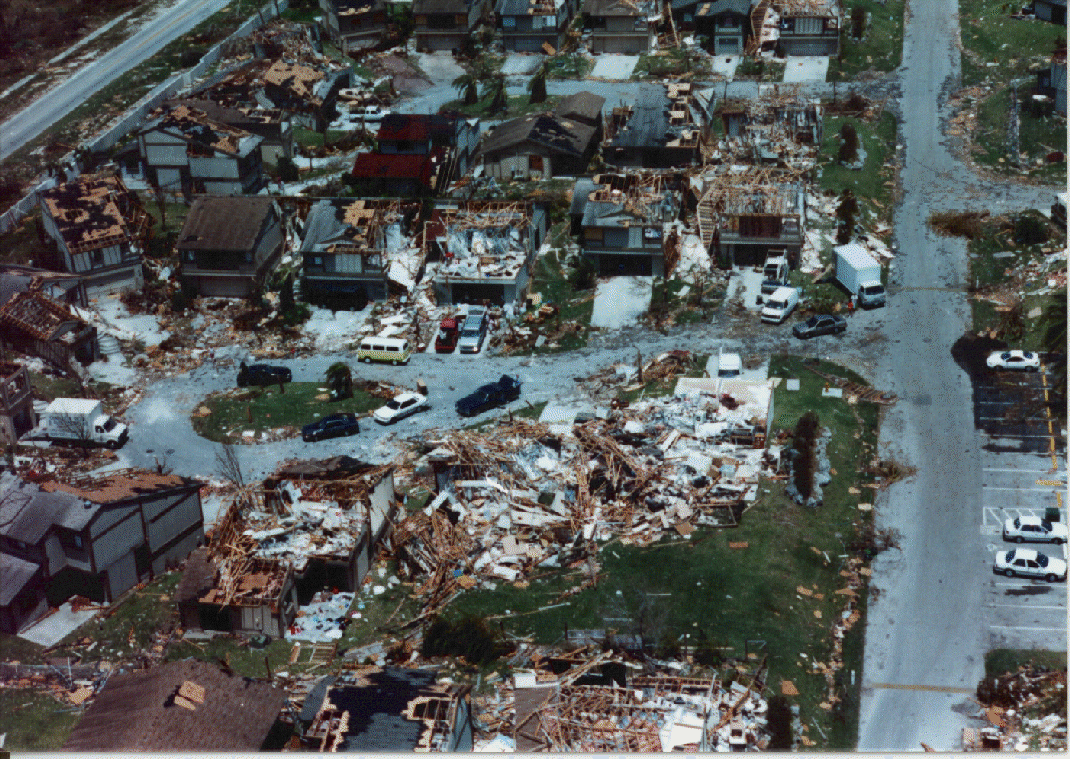
Reading this Katrina weblog entry reminded me that Hurricane Andrew in 1992 was one of only three category 5 hurricanes to make landfall in the U.S. in the last century.
My wife M.C. Moewe covered that monster storm for the Fort Worth Star-Telegram. She interrupted a Disney World vacation with her parents, driving to South Florida in time to experience the eyewall passing overhead in the company of local police. For most of the three-hour trip, her car was the only one heading south.
Covering the story was my suggestion. Back in Fort Worth, I told her Andrew was becoming humongous and she'd be asked to report on it if she told her editors where she was. Her mother was not happy about my idea, as I learned the next time we met. I am fortunate that she is not predisposed to violence.
I didn't know anything about hurricanes at the time, having lived my entire life in the Dallas/Fort Worth Metromess. Now that I'm an eight-year Floridian, I am known for premature evacuation. I was the first person to leave for Hurricane Frances last year, taking off 24 hours before TV news channels began covering the exodus, and I went one state more northward than anyone else.
In retrospect, sending the future mother of my children into this wasn't the best idea I've ever had.
Hurricane Katrina: 'Do Not Call 911'
LiveJournal business manager Mark Kraft is gathering information for Gulf Coast residents bracing for Hurricane Katrina, collecting reports from several LiveJournal diarists who are fleeing or preparing to ride out the storm.Kraft passes along a grim prediction from meteorologist Jeff Masters:
I put the odds of New Orleans getting its levees breached and the city submerged at about 70 percent. This scenario, which has been discussed extensively in literature I have read, could result in a death toll in the thousands, since many people will be unable or unwilling to get out of the city. I recommend that if you are trapped in New Orleans tomorrow, that you wear a life jacket and a helmet if you have them. High rise buildings may offer good refuge, but Katrina has the potential to knock down a high-rise building.
The 4 p.m. National Weather Service warning for New Orleans was equally foreboding:
Most of the area will be uninhabitable for weeks ... perhaps longer. At least one half of well constructed homes will have roof and wall failure. All gabled roofs will fail ... leaving those homes severely damaged or destroyed.
The majority of industrial buildings will become non functional. Partial to complete wall and roof failure is expected. All wood framed low rising apartments will be destroyed. Concrete block low rise apartments will sustain major damage ... including some wall and roof failure.
High rise office and apartment buildings will sway dangerously ... a few to the point of total collapse.
Government officials did their best to scare the hell out of residents all Sunday morning, hoping they'd leave by any means possible. One told holdouts to make sure they had a hammer or some other tool that's strong enough to break through an attic roof. "You don't want to drown in there when the water comes," he said.
Several parishes in Louisiana have closed emergency services, giving their residents a discordant bit of advice: Do not call 911.
In January, the PBS series Nova broadcast a 12-minute segment that illustrates the nightmare scenario of a major hurricane hitting New Orleans: 50,000 dead, one million homeless, and a new lake where New Orleans used to be.By my estimation, the water level would be high enough after a levee overflow to put this Bourbon Street webcam underwater -- even though it's 20 feet off the ground.
Sven Latham found more New Orleans bloggers in a latitude/longitude search of Blogwise, including one who feared being trapped there before neighbors offered a ride out:
There are about one-hundred thousand people in New Orleans with 'no place to go and no way to get there'. I'm one of those people.
Bloggers Run From Hurricane Katrina
Looking around New Orleans with GeoURL, I've yet to find a blogger sticking around for Hurricane Katrina.New Orleans TV station WWL is in 24-hour hurricane news mode, which is incredibly unnerving to experience, as I learned in Palm Coast, Florida, during Hurricane Floyd. A direct hit of a category 4 storm would cause Old Testament flooding in New Orleans, which averages eight feet below sea level and survives only because of levees. Residents have lived for years in dread of a storm that would demonstrate why this is terrible engineering, turning the city into Atlantis:
New Orleans has always had a complicated relationship with the water surrounding it. Everyone told the first settlers this was the wrong place to build a city. It is wedged precariously between the mighty Mississippi and Lake Pontchartrain, and most of it was once swampland. Aggravating the problem is the fact that much of New Orleans is below sea level, so that after a good rain, the water just settles in. There is now a decent pumping system, which helps. Old-timers, however, still talk of the days when, after a bad storm, bodies washed out of the cemeteries.
Jeffrey Masters, a meteorologist who was on a plane that nearly crashed in the eye of Hurricane Hugo, is covering the storm for Weather Underground:
A stretch of coast 170 miles long will experience hurricane force winds, given the current radius of hurricane force winds around the storm. A direct hit on New Orleans in this best-case scenario may still be enough to flood the city, resulting in heavy loss of life and $30 billion or more in damage.
The closest blogger who's sticking around appears to be T.C. Byrd, providing updates on the storm's approach from Hattiesburg, Mississippi:
On the Coast, if you are not following the mandatory evacuations, they are coming around and making you sign a waiver stating your vital stats and that the city can dispose of your body. There's already some flooding. Katrina ain't playing.
Update: An episode of Nova on PBS described New Orleans' nightmare scenario.
Choosing an Official RSS Mime
A new article on Advogato proposes an extension to the RSS MIME type. The proposal's premised on a few misconceptions about RSS, but Advogato's trust-metric system doesn't trust me enough to comment.RSS isn't a single format with "a multitude of different incompatible RSS versions." There are two formats: the RDF-based RSS 1.0 and the slightly simpler RSS 2.0.
Neither format defines application/rss+xml as the MIME type for RSS, and it isn't officially recognized by the Internet Assigned Numbers Authority.
RSS 1.0 has a recommended MIME type of application/xml, but it may change to application/rdf+xml in the future.
RSS 2.0 makes no recommendation, and there's disagreement over whether it's better to use text/xml instead of application/rss+xml so an RSS feed can be viewed in browsers.
I'm using text/xml on my sites in the absence of an official type for RSS 2.0.
On Advogato, the community rates me as an Apprentice in the open source world. I may earn promotion to Journeyer, but with enough experience points, I hope to become a Prestidigitator or Thaumaturgist.
Fixing a Pending Urchin Task
I check web stats with Urchin 5.6, a server log reporting program that's available for Windows, Linux, MacOS, and other systems.Urchin does the job reasonably well, but at least once a month the program's scheduler gets stuck reading a site's log, hanging forever as a "pending" or "running" task.
I found the solution to the problem on an Urchin support page: Stop the scheduler, use the utility program to set several values that reset the stuck site, then restart the scheduler.
Update: Spoke too soon. I also had to open the Storage/DB configuration tab for the profile, delete all data associated with it, and delete its server logs for recent days. Something in the database or the log caused the pending problem to come back each time I ran Urchin.
The Mess in Messaging
In a story about Yahoo's competition with Google, spokeswoman Terrell Karlsten said that Yahoo is committed to interoperability between instant messaging services.She also said Yahoo! was an "active advocate" of allowing users to communicate with people using other instant messaging services -- something Google Talk already offers -- provided users' security was not affected. However, this isn't something Yahoo! offers to customers at the moment.
I've been waiting for years to see the big companies break down the walls between their IM services. I use Trillian to receive instant messages over four accounts I have on ICQ, MSN, Yahoo, and AOL, and that's four too many; no one would use e-mail if you had to set up an account on each server that might send you a message. Making matters worse, clients like Trillian have to be updated frequently just to keep functioning with these services.
I was curious about what the "active advocate" comment meant, so I e-mailed Karlsten for details. She replied that Yahoo's commitment is demonstrated by its participation in Microsoft Live Communications Server 2005, a messaging program for businesses that works with MSN, Yahoo, and AOL.
The program, which is priced for businesses at $1,199 with five user licenses, supports the non-Microsoft servers with the purchase of an additional access license.
"We continue to support efforts towards opening the IM community in a seamless, convenient and secure manner," Karlsten wrote.
Google Talk launched with support for any Jabber messaging client because of its implementation of XMPP, giving millions of instant messaging users a reliable connection to Google Talk users from day one of the service.

Social Media

Subscriptions

Blogroll
Projects
RSS Advisory Board
How to Read an RSS Feed with Java Using XOM
The RSS Advisory Board Just Turned 20
Downloading 50,000 Podcast Feeds to Analyze Their RSS
Tara Calishain Explains: What is RSS?
Be Unique And Use RSS Guid Like Everybody Else
Statistics

This blog has been published since Nov. 7, 1999 (a span of 9,808 days).
Thank you for visiting Workbench.
