As you enter Disney World Epcot, you pass granite monuments covered with thousands of postage stamp-sized etched metal portraits.
Getting a single picture on a Leave a Legacy monument costs around $35, and I've always regarded it as a very moving tribute to Disney's ability to separate millions of dollars from their original owners.
However, on my last trip I glanced over a few of the portraits, spotting one next to a woman and child with an inscription "Cesar Alviar 9-11-2001."
Alviar was a Marsh & McLennan accountant who died in Tower One of the World Trade Center.
Tracking an IP Address
A person calling himself Ranveer of Mumbai visited the Drudge Retort last night, posting three memorable anti-American rants:... you have the gall to talk about not finding anything pure to drink in India other than Coke? Even our cows' urine is more pure than your drinks.
As I checked the IP address to see if Ranveer was really posting from India, I thought the links might be useful to others. Here's what I do when playing Scooby Doo Internet detective:
- The IP address to host name service reveals the name associated with an address, if one has been defined.
- A traceroute service identifies each hop from a chosen server to the address.
- Three WHOIS registrars -- APNIC, ARIN, and RIPE -- can tell you what company controls an IP address.
The WHOIS registrars cover different regions, so for any IP address, one provides a definitive answer and the others offer generic information covering the entire IPv4 Internet (the range 0.0.0.0 to 255.255.255.255).
For example, ARIN identifies that the address 207.46.130.108 belongs to Microsoft, while APNIC and RIPE come up with bupkiss.
The only thing that worked on Ranveer was APNIC. He posted his comments from an address owned by REACH, a global Internet provider that specializes in Asian connectivity and has offices in Mumbai.
Another Reason for Tower's Cabinet Defeat
In a story on secrecy in Washington, Post writer Sally Quinn drops a bomb on the late Sen. John Tower:
... John Tower, the powerful Republican senator from Texas, was nominated to be secretary of defense, a job he badly wanted. Tower had a reputation as a serious womanizer. It was a poorly kept secret on the Hill, but most women wouldn't talk. Only one or two had the guts to speak up. Tower, who was a friend of my father, had attempted to sexually assault me when I was 18 and a college freshman. Embarrassed and ashamed, I had kept this story a closely guarded secret for years.
One day, during Tower's confirmation hearings, two FBI officials showed up at my front door and asked me to tell them about the incident. I refused to confirm it. "But you don't understand," one of them said to me, "this will be totally confidential." I burst out laughing. "Are you kidding?" I said. "Where do you think The Washington Post gets its stories? From guys like you who leak."
As it turned out, there were enough stories like mine to deny Tower his confirmation. And later, Anita Hill made a mistake I did not, when she agreed to testify "confidentially" about Supreme Court nominee Clarence Thomas.
Tower, who died in a 1991 plane crash, had a reputation as a drunken womanizer that helped defeat his nomination by the first President Bush to be Defense Secretary -- the first Cabinet choice rejected by the Senate in 30 years.
Tower's never been accused of attempted rape before, based on my search of news accounts. When his treatment of women was scrutinized during the 1989 confirmation process, the public only heard about Benny Hill-style shenanigans like chasing a secretary around a desk. In 1998, Washington Times columnist Suzanne Fields even wrote that he was rejected "because he was seen putting a hand on the knee of a woman under the table at a restaurant."
Tower's entire FBI file was shared confidentially with senators. If any sex-assault allegations were included, that detail didn't make the press, according to the Los Angeles Daily News in 1997:
While the raw FBI files contained words like "extremely inebriated" from unnamed witnesses, and the final report apparently concluded that Tower had once had a drinking problem, the White House concluded that the FBI did not corroborate the most serious charges against him.
The Senate has had its share of notorious horndogs in recent decades, including Bob Packwood, Strom Thurmond, Gary Hart, and Ted Kennedy. Tower once said of Thurmond, imagining his future funeral, "they'll have to beat his pecker down with a baseball bat to close the coffin lid."
If Tower's behavior with women reached a point that his fellow senators took offense, there had to be some horrible stuff in that FBI file.
Teaching Kids to Leapfrog a Jackass
I've been ending each day by reading a chapter of The Great Brain to my sons, the first book in a series by John D. Fitzgerald that I devoured as a child.The books, which detail life for three Catholic brothers in a Mormon town in 1890s Utah, describe a time when children weren't raised like bubble boys (my preferred technique). They explore caves, test their mettle with fistfights under rough and tumble lumberjack rules, and do demented things like this:
"We are playing Jackass Leapfrog," Sammy said as he led the immigrant boy to the center of the lot. He pushed the Greek boy's head down in position to play leapfrog. "You are the jackass," Sammy said as if the new kid understood English. "Now stay that way."
The rest of us kids lined up with Sammy in the lead.
"Whack the jackass on the rump!" Sammy shouted as he ran and leapfrogged over Vassillios with one hand while he whacked the Greek boy on the rump with the other hand.
The rest of us followed, whacking the jackass on the rump.
As it turns out, the term "jackass" is comedy gold to kids.
The protagonist, the narrator's brother who calls himself the Great Brain, discovers that Vassillios has formidable wrestling skills, solving his troubles with Sammy -- a dreadful child whose father derides immigrants for taking American jobs.
Reading this chapter, I wondered if Fitzgerald's 1969 book could survive the ideological cleansing that conservatives are waging in schools and overprotective liberal do-gooding that would purge fights and Jackass Leapfrog.
Cruise Passengers Lost at Sea
My wife M.C. Moewe, a reporter for the Jacksonville Business Journal, has been chasing an elusive story over the oceans of the world for several months: Cruise ship passengers who vanish while their vessels are at sea.At least 12 passengers have gone overboard or disappeared since 2000, including five on Carnival Cruise Lines ships within the past 12 months. Some are suicides, others accidents, and at least one incident suggests the possibility of foul play. One was lost coming into Jacksonville last Thanksgiving, a new port for cruise embarkation.
Many incidents are completely unexplained, including one man who survived by swimming 17 hours until being spotted by a cargo ship. He awoke in pitch-black sea with no shoes, no pants, no ship, and no explanation for how he ended up in the water during a voyage to Cozumel, Mexico.
Because these people often go missing in open ocean, they may be the most difficult to resolve missing persons cases in the world. When your endangered missing adult report has a locale of "Int. Waters, San Juan, Puerto Rico," the futility of the case is pretty clear. The cruise industry does not track incidents.
Some victims even receive marketing mail after the cruise:
Crystal Tinder's 37-year-old fiance, Christopher Caldwell, went missing off the Carnival Fascination during a July sailing. A contact from Carnival came shortly after the cruise.
"Chris got an e-mail from the Carnival booking agent asking him if he enjoyed his cruise," Tinder said.
It's a Gay World After All
My family visited Disney World this weekend, the last before our yearly passes are blocked for the summer. Riding to the Magic Kingdom, I saw a young man wearing a T-shirt tight enough to reveal that Disney keeps the monorails pretty cold. The shirt read "I only hang with pretties."Entering the park, we were greeted by an unusually large number of people in red shirts, mostly clustered in groups of the same gender. We had unsuspectingly visited during Gay Days 2005.
This week, many an unsuspecting American family will travel to Walt Disney World, where they will find themselves at the epicenter of a recurring cultural earthquake.
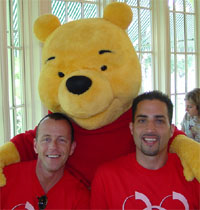 Every year religious conservatives like Mark Alexander write about the horror of families faced with the shocking realization that gay people attend theme parks. What will I tell the children?
I recalled the warning from the Christian Action Network to expect an orgy of depravity, and asked my mother to get the camera out.
Though we spotted several hundred people (and Winnie the Pooh) wearing red, there wasn't a single shirtless homosexual, nipple twist, or groin fondle to be seen. Apparently, the insidious gay agenda requires that they pass among us by feigning interest in riding rides, gorging on meals, and buying overpriced memorabilia. Most of them didn't even have smart haircuts.
The only public display of affection any of us witnessed was a middle-aged woman squeezing her husband's Charmin after Buzz Lightyear Space Ranger Spin. Those seats inhibit circulation.
Perhaps the orgy of depravity was cancelled because the Tomorrowland Transit Authority, which my wife assessed at age 14 as the best make-out ride in the park, was broken down that day.
The only troubling moment that could be blamed on gays was getting stuck behind a sleuth of bears from Jacksonville headed to Tomorrowland. Getting a stroller around them in a hurry was like trying to score on a goal-line defense.
Looking Deeper into Joan Felt
The press has encamped itself outside the Santa Rosa, Calif., home where Mark Felt lives with his daughter Joan, waiting for the next move from Family Deep Throat.Joan Felt, who has said she'd like to "pay some bills" from their notoriety, is described in today's Washington Post as a Sonoma State University Spanish lecturer and former Fulbright scholar.
Reporters have yet to discover her association with a spiritual group called Adidam, brought to light by members of an online discussion group about the movement.
Joan Felt's phone number, which has been publicly listed, turned up on three official Adidam sites as the contact for a study group in Santa Rosa. The pages have recently been deleted or edited to remove her name and phone number, but could still be found Friday morning in Google's cache. I was unsuccessful contacting her by e-mail or phone.
Adidam has 1,000 to 3,000 adherents, according to a Religious Movements project published by the University of Virginia.
Santa Rosa lies around 45 miles from the Mountain of Attention, a 1,000-acre "meditation retreat" in Lake County that was for many years the headquarters of the movement and founder Adi Da Samraj's residence.
Some members have resided communally and devoted their lives to Adidam, as described in a member's book about joining in the '70s:
Friday evenings were yours, every other moment was filled. We took up the disciplines of meditation, service, study, meeting and consideration, a purifying vegetarian diet, confinement of sexuality to twice a month, right livelihood, and maximizing our tithe or financial support.
Another member account from a few years later describes it differently:
I have gotten along well in the Adidam organization ... never got badly burned by anyone because of doing something I really didn't want to do. I read accounts about people being "forced" to eat a certain way, or "forced" to give money ... certainly hasn't been my experience.
A lawsuit filed by three former Adidam members in 1985 alleged that adherents impoverished themselves while the group's founder lived opulently with nine wives and 30 followers on a Fiji island bought for $2.1 million from the actor Raymond Burr.
In 2002, J. Todd Foster was in discussions with the Felt family while preparing a magazine story on Deep Throat's identity. The former freelance journalist wrote about it this week for The News Virginian in Waynesboro, Va., where he serves as managing editor:
Ultimately the story died because of money. The Felt family and their attorney wanted a lot of money, and People magazine -- with my blessing -- backed away in what would have been a case of "checkbook journalism." Reputable news organizations don't pay a penny for news.
In an e-mail this morning, Foster told me the subject of Adidam never came up with the Felts: "My partner dealt with Joan, and she didn't mention it to him either. Money was a prime motivator, but mostly for her son's law school bills."

Social Media

Subscriptions


Blogroll
Projects
RSS Advisory Board
How to Read an RSS Feed with Java Using XOM
The RSS Advisory Board Just Turned 20
Downloading 50,000 Podcast Feeds to Analyze Their RSS
Tara Calishain Explains: What is RSS?
Be Unique And Use RSS Guid Like Everybody Else
Statistics

This blog has been published since Nov. 7, 1999 (a span of 9,807 days).
Thank you for visiting Workbench.
