Want Out of Wikipedia? Fight to Stay In
If you dive into the Wikipedia talk page on Seth Finkelstein, you'll find his interesting and utterly futile effort to be deleted from the encyclopedia. Getting a piece in The Guardian isn't helping his claim to be insufficiently famous at all.On the mailing list WikiEN-L, Steve Summit identifies a law of Wikipedia that should become known as the Finkelstein Paradox -- a subject who argues he doesn't belong in Wikipedia is more likely to remain in Wikipedia:
I was struck by Seth's account of how he "strongly argued the case against myself" at AFD. I suspect that a biographical article's subject tends to carry significant but paradoxical undue weight at AFD, in two contradictory directions. Subjects who argue that they are notable and that their articles should be kept are obviously vain self-promoters, so their articles should obviously be deleted. But subjects who argue that their articles should be deleted are obviously trying to hide something (or, at least, to unjustly influence the free flow of information), so their articles should obviously be kept.
It's too late for Finkelstein, but others can learn from his predicament. If you're added to Wikipedia and don't want to be there, show up for the ArticlesForDeletion (AFD) debate and argue the merits of your fame as passionately as your mother would. Edit your own entry and add a few accomplishments and personal qualities that other editors wrongly overlooked. Deride your critics in as supercilious a tone as you can muster.
The Wikipedia editors who show up for deletion votes will respond to these acts like a shark that smells blood in the water.
A tragic story in today's Houston Chronicle has an unfortunate ad juxtoposition: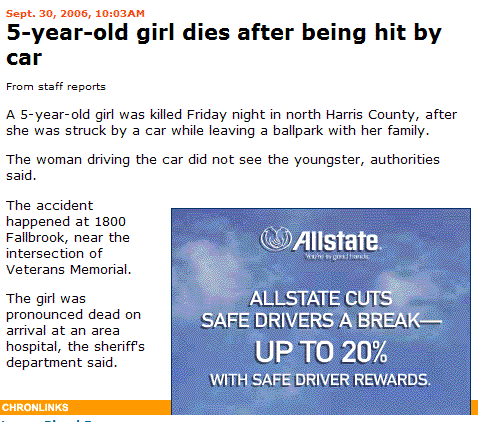
The ad's animated, showing an SUV stopping safely and avoiding a child's ball bouncing into the road. "You always stop," it begins. "You always drive safely. You deserve a reward."
Wikipedia Leader: I Want to Be Deleted
In a provocative commentary for The Guardian, Seth Finkelstein argues that having a biography in Wikipedia is a magnet for libel:For people who are not very prominent, Wikipedia biographies can be an "attractive nuisance". It says, to every troll, vandal, and score-settler: "Here's an article about a person where you can, with no accountability whatsoever, write any libel, defamation, or smear. It won't be a marginal comment with the social status of an inconsequential rant, but rather will be made prominent about the person, and reputation-laundered with the institutional status of an encyclopedia."
As someone who contributed several biographies to the encyclopedia, I've held to the belief that as a person's entry becomes more well-read, it will attract conscientious editors at a greater rate than harmful ones. I still have all of the entries I've created on my watch list, and none has experienced the kind of abuse Finkelstein describes.
Like me, Finkelstein hovers close to being too obscure for Wikipedia. His biography only had been edited 53 times in two years before this Guardian piece ran.
When an entry's not well-read, the potential for abuse is greater because an edit by someone with an axe to grind is less likely to be reviewed by others.
The press should follow up on something Finkelstein reveals in his commentary -- Angela Beesley, the Wikipedia Board of Trustees member who recently quit, has been fighting to have her own biography deleted:
I'm sick of this article being trolled. It's full of lies and nonsense. My justification for making a third nomination is that my circumstances have changed significantly since the last AfDs -- I have resigned from the Board of Trustees of the Wikimedia Foundation. Given that this was previously kept on the grounds I was on that Board, there is no longer any reason for this page to be kept. This has already been deleted on the French and German Wikipedias.
Beesley's clearly too well-known to justify deletion from Wikipedia, considering her position as one of the site's leaders for three years. But as Finkelstein notes, this is a huge no-confidence vote in the Wikipedia concept. If she can't get fair treatment on Wikipedia, and founder Jimbo Wales has resorted to protectively editing his own bio on numerous occasions, what confidence should other living subjects have in their own treatment?
USPTO Rejected 'Podcast' Trademark Registration
I submitted a proposal today urging the RSS Advisory Board to support the common usage of "podcast" and "podcasting" as generic terms that cannot serve as trademarks for Apple Computer or any other entity.Since its coinage in 2004, the word "podcast" has referred to all audio files delivered as RSS enclosures. This usage became so popular that "podcasting" was declared the 2005 word of the year by the editors of the New Oxford American Dictionary, who gave it the following definition:
A digital recording of a radio broadcast or similar program, made available on the Internet for downloading to a personal audio player.
I found something in the U.S. Patent and Trademark Office Database that bolsters my claim: On Aug. 29, a USPTO trademark examiner rejected an attempt to register "podcast" as a trademark.
Paul Fowlie of Common Mode Inc. attempted to trademark "podcast" on March 8 for the following class of goods and services:
SOUND RECORDING FEATURING AUDIO INFORMATION FOR DOWNLOAD-SPOKEN WORD AND MUSIC
To see the registration, search the trademark database for the registration with serial number 78831795. On the registration page, click the "TDR" link to see USPTO trademark attorney Monique C. Miller's refusal of the registration.
Miller writes that "podcast" is "merely descriptive," meaning that it describes an entire class of goods and thus cannot function as a trademark:
The term PODCAST may be defined as:
"A free, downloadable audio file that can be listened to on your computer -- where you can burn it to a compact disc -- or on an MP3 player or iPod to enjoy on planes, trains and automobiles. Podcasts were originally thought of as amateurish audio versions of blogs, but no longer; ESPN, NPR, the BBC, Newsweek, news commentators and other highly respected people have podcasts readily available." (See attached definition from www.netlingo.com)
Or
"An audio programme in a compressed digital format, delivered via an RSS feed over the Internet to a subscriber and designed for playback on computers or portable digital audio players, such as the iPod." (See attached definition from http://en.wiktionary.org)
The mark immediately describes and names the characteristics and features of the goods. Accordingly, the mark is refused registration on the Principal Register under Section 2(e)(1) of Trademark Act.
Additionally, the examining attorney submits that the term PODCAST may be unregistrable because it is generic or informational for applicant's services. Generic terms are terms that the relevant purchasing public understands primarily as the common or class name for the goods or services. In re Dial-A-Mattress Operating Corp., 240 F.3d 1341, 57 USPQ2d 1807 (Fed. Cir. 2001); In re American Fertility Society, 188 F.3d 1341, 51 USPQ2d 1832 (Fed. Cir. 1999); In re Merrill Lynch, Pierce, Fenner & Smith, Inc., 828 F.2d 1567, 4 USPQ2d 1141 (Fed. Cir. 1987); H. Marvin Ginn Corp. v. Int'l Ass'n of Fire Chiefs, Inc., 782 F.2d 987, 228 USPQ 528 (Fed. Cir. 1986). Generic terms are by definition incapable of indicating a particular source of the goods or services, and cannot be registered as trademarks; doing so "would grant the owner of the mark a monopoly, since a competitor could not describe his goods as what they are." In re Merrill Lynch, 828 F.2d at 1569, 4 USPQ2d at 1142. Applicant's mark is so common in the field that it appears to be unregistrable. (See attached evidence from a search of the Internet). The attached sample of the Internet evidence submitted is evidence of the public's perception of the term.
As evidence, Miller attached the Wiktionary and NetLingo definitions of podcast, a Google search for podcast and audio and recording and trademark registration attempts for "Emergency Podcast System," "Cherry-Picked Podcasts That Don't Suck," "What I Want Podcasting," "Podcast Realty," "VarBusiness Podcast" and "EPodcast."
Adopting a Common OPML Icon
 Liquid Orb Media and Chris Pirillo are trying to popularize a common OPML icon to identify OPML subscription lists.
I'm no fan of OPML, but this icon's such an improvement over the alternatives I wanted to promote it. The similarity to the common icon for RSS should help spur adoption, since the formats complement each other.
I've added an OPML link to the sidebar on Workbench that shows an example of how it could be used. The link opens an OPML file that lists feeds I'm reading with Bloglines.
You Stay Classy, Indianapolis Colts
Indianapolis Colts punter Hunter Smith took a weird shot at the Jacksonville Jaguars after their game Sunday:Jacksonville is like a stand-up comic who can only use vulgarity and curse words because he lacks intelligence and lacks class. He really doesn't have anything to say. Our intangible is our class and our intelligence. A team that gets personal fouls the way they do, the roughing penalties, they just don't have any material.
That may be the most haughty insult I've ever heard from an NFL player. Even better, two of the Jags' personal fouls involved soccer-style fakery by the Colts. Jaguars Coach Jack Del Rio called them "Bill Laimbeer flops" after the game.
On one play, Colts linebacker Cato June pretended to be kicked by receiver Reggie Williams, falling to the ground as if he were shot to draw the personal foul flag. On another, June pretended to lose his balance after a pileup and threw his body into offensive lineman Vince Manuwai, who pushed him off in a tame "get out of my face" gesture and drew an unnecessary roughness penalty.
War Widow Brought Bush to Tears
In a personal visit with President Bush, the widow of a soldier killed in Afghanistan claims she brought him to tears and admonished him, "It's time to put our pride behind us and stop the bleeding, for all of us."The anecdote appears in a Washington Post front-page story this morning about the president's private feelings regarding the wars in Iraq and Afghanistan.
[Hildi] Halley, 41, lost her husband, National Guard Capt. Patrick Damon, also 41, in June in Afghanistan to what officially was ruled a heart attack. When Sen. Olympia J. Snowe (R-Maine) called to offer condolences and asked if she could do anything, Halley requested a telephone call from the president. Instead, when he came to Maine to visit his parents in Kennebunkport, the White House invited her to meet him at a school.
When Bush walked in, Halley told him about Patrick, how they had met at American University, moved to Maine and had a family. "After I spoke about my husband for quite some time, I said, 'And now he's dead. For what? Why? I've lost my soul mate.' " She asked her children, Mikayla, 14, and Jan-Christian, 12, to leave the room, then wept as she told Bush how hard life had become for them. "He started crying. I said, 'These two children do not like you and they have good reason for that. And I hold you responsible for the death of my husband.' "
Bush seemed surprised that she opposes even the war in Afghanistan, and he cited the Taliban. "And I said, 'Who put them in power?' And he got a little defensive and said, 'I'm really not here to discuss public policy with you.' And I said, 'That's probably wise, and I'm not here to talk about public policy, either.' "
Bush said he hoped their meeting helped her healing. "You know what would help my healing?" she recalled responding. "If you change your policies in the Mideast." Bush smiled, she said, but did not reply.
Halley said the meeting did not change either of their minds. She would still vote against him. But she said she appreciated that he opened himself up to her. "I don't think he's a heartless man," she said. "I think he's pulled in a lot of different directions by very intelligent people. . . . I don't think it's going to change his policies, but I hope it does make him think about it. I hope I'm in his dreams."

Social Media

Subscriptions

Blogroll
Projects
RSS Advisory Board
How to Read an RSS Feed with Java Using XOM
The RSS Advisory Board Just Turned 20
Downloading 50,000 Podcast Feeds to Analyze Their RSS
Tara Calishain Explains: What is RSS?
Be Unique And Use RSS Guid Like Everybody Else
Statistics

This blog has been published since Nov. 7, 1999 (a span of 9,819 days).
Thank you for visiting Workbench.
